On the surface, it seems like a strange fit.
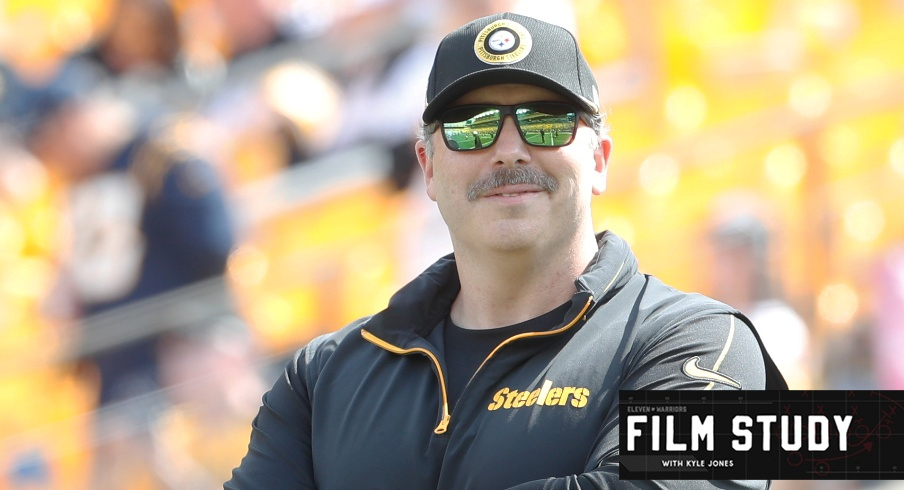
Ryan Day hired another NFL coordinator with head coaching experience in Arthur Smith, albeit without the Super Bowl pedigree Matt Patricia came with a year ago. The former Steelers offensive play-caller won't seemingly be missed by the fans in Western Pennsylvania after producing an offense that was middle-of-the-road by virtually every metric.
But beyond the numbers, what initially surprised many in the industry is the fit between Day's system and Smith's, as the Ohio State head man has largely remained in charge of the offense since arriving in Columbus, even when others have physically called plays on Saturdays. That system, of course, is best known for prolific passing games that have rewritten record books and produced a busload of talented receivers, which is quite different than Smith's offenses in Tennessee, Atlanta, and Pittsburgh.
Upon further review, however, the fit becomes much clearer. Like former Buckeye OC Kevin Wilson, Smith is a former offensive lineman at the University of North Carolina who cut his teeth as an assistant OL and TE coach. Much more importantly (and also like Wilson), Smith's foundational run scheme is the wide/outside zone (aka Stretch) which acted as the foundation for Day's early OSU offenses.
While many 11W readers are likely aware by now of Smith's resume, it's worth pointing out that Smith was preceded as the Titans' offensive coordinator by Matt LaFleur, who famously came out of the Shanahan family coaching tree. Anyone who has followed the NFL at any point in the past three decades knows that those coaches rely on wide zone runs and build the rest of the offense off that action with designed cutbacks and play-action passes that punish teams for overplaying the concept.
When LaFleur left to be the head coach in Green Bay after just one season in Nashville, prompting Mike Vrabel to promote Smith to the coordinator role, it was with the idea of keeping the system in place. The Titans featured one of the best offenses in the league that season, finishing fourth in fourth in scoring and second in total yards with a system built around Derrick Henry, who led the league in rushing.
While Smith's offenses have failed to find the same success in the five seasons since then, it's clear that the basic philosophy remains. The Steelers ran zone plays nearly twice as often during the 2025 season as 'gap' concepts like Power or Counter, with more runs aimed outside the tight ends than anywhere else.
| GAP | Left D | Left C | Left B | Left A | Right A | Right B | Right C | Right D |
|---|---|---|---|---|---|---|---|---|
| ATT | 83 | 24 | 34 | 53 | 40 | 37 | 27 | 75 |
| YDS | 319 | 82 | 194 | 243 | 146 | 149 | 85 | 462 |
| YPA | 3.8 | 3.4 | 5.7 | 4.6 | 3.6 | 4 | 3.1 | 6.2 |
| TD | 5 | 1 | 2 | 2 | 0 | 1 | 0 | 2 |
| 1ST | 21 | 6 | 10 | 14 | 8 | 8 | 7 | 20 |
| 10+ | 7 | 3 | 5 | 4 | 2 | 4 | 2 | 15 |
While Smith worked with LaFleur for just one year, the Shanahan tree's trademark of scheming up ways to make the wide zone runs successful are readily apparent. Smith is a firm believer in mastering a handful of concepts, but dressing them up with different formations and pre-snap motions that stress the defense and create running lanes:
Pre-snap motion was common in Pittsburgh, occurring on roughly 52% of snaps last season. But as seen above, Smith often called for multiple actions, shifting multiple players before the snap to force the defense to adjust only to have a player move at the snap, creating commotion.
The result was one of the league's most effective rushing attacks, even though Jaylen Warren and Kenneth Gainwell are considered household names to Iron City drinkers. Smith's run game ranked 8th in the league last season in yards before contact per rush at 1.4, creating numerous lanes for the two backs.
Although Smith had a pair of young, first-round draft picks at tackle to work with in Broderick Jones (drafted in '23) and Troy Fautanu ('24), but the key schematic piece in Smith's run game is the use of tight ends. As seen in the clip above, Smith will move them all over the field, asking them to play on the line, in the backfield, or split out wide on any given play.
Going back to his time in Tennessee, Smith hasn't shied away from leaning on his tight ends to be critical cogs in the run game, often lead blocking for the ballcarrier in lieu of a traditional fullback.
Tight ends aren't the only skill players who contribute to the blocking scheme in Smith's offense. With a heavy reliance on condensed formations, Smith creatively deploys wide receivers in the run game, much the same way Emeka Egbuka regularly contributed when Ohio State ran the ball under Chip Kelly's guidance in 2024.
All these schematic wrinkles make life relatively easier on the offensive line, moving defenders away from the play and bringing extra blockers to create gaps that must filled by the defense. This should be a welcome addition to the returning Buckeye linemen, many of whom struggled to execute their assignments well before reaching the postseason.
But by taking some pressure off the blockers, Smith requires his running backs to be patient and identify the open gap only once the ball is in their hands. This will be a departure from the gap schemes called so often last season in Columbus that bear the moniker due to being designed to hit a specific gap.
One of Smith's favorites is a common NFL change-up to outside zone known as Duo, which initially looks like a zone play but hits the opposite direction. Instead of trying to move laterally around the defender, as happens on outside zone runs, the offensive line simply tries to push the defenders laterally with a pair of double-teams on the defensive tackles.
The goal is not to ultimately block the middle linebacker but to get him caught in the traffic in front of him, with the runner reading his movements to find a lane:
While Warren and Gainwell may not possess the same physical gifts as Henry, their vision allowed them to tally over 1,500 yards combined while splitting reps. For this reason, the absences of Bo Jackson and Isaiah West in spring practice due to injuries may be a bigger deal than first thought.
Readers will have, by now, recognized that many of these clips feature multiple tight ends, something Day recently claimed was not his desire when discussing Smith's hiring. When appearing on The Ryan Day Show last week, Day said the Buckeyes “want to play with three wide receivers in the game as many times as we can and mix in the tight ends.”
That declaration seems at odds with Smith's personnel usage. While in Tennessee, he was early to the trend of using two tight ends regularly, and hasn't backed away from it, using 12 personnel (1 RB, 2 TE) roughly a quarter of the time last season.
While that may seem like a lot, it's worth noting that the Buckeyes employed multiple tight end looks more often than most teams at the FBS level. Additionally, the Buckeyes hit the transfer portal to replace the departed Will Kacmarek and Max Klare, signaling Day's intent to continue in this direction.
| Personnel | PIT Usage | NFL Avg |
|---|---|---|
| 11 | 38.7% | 56.4% |
| 12 | 24.7% | 22.3% |
| 13 | 14.17% | 5.32% |
| 21 | 2.3% | 6.3% |
| 11 (6OL) | 9.9% | 1.6% |
| 12 (6OL) | 8.3% | 2.2% |
But while Ohio State fans may be looking for someone to put more wide receivers on the field, their team's new OC often goes the other direction. The Steelers ran the second-most snaps of 13 personnel in the league, the majority of which came on early downs outside of the red zone.
Additionally, Smith embraced the use of six offensive linemen in place of a receiver, going bigger at a time when nearly all NFL 'base' defenses feature five defensive backs.
Such words will likely elicit strong reactions from many readers, but those still reeling from the Big Ten Championship ought to keep an open mind with Smith's use of so many big bodies at once. While we'll get into the ways this opens up the play-action passing game next week, it's not as though the Steelers simply lined up in a short-yardage formation and rammed the ball straight ahead when going big:
All this creativity in design can't mask basic failures in execution, however, and anyone who watched a Steeler game last fall will tell you these still happened far too often. Smith will be asked partner with OL coach Tyler Bowen to ensure such occurrences are rare.
Ultimately, however, the 2026 Ohio State offense will still revolve around its Heisman-finalist quarterback and the alien who lines up at the X position and wears #4. While that was also the case this past season, with defenses designing game plans around containing Day's vaunted passing game, the Buckeyes couldn't punish teams on the ground for focusing on stopping the pass.
By bringing in Smith, Day isn't surrendering his system to someone else. He's bringing in a veteran play-caller who should be able to force defenses to account for the ground game, which in turn will allow the passing game to be more explosive.