Ohio State’s coaching staff resembles an NFL coaching staff more than it ever has before, and Ryan Day believes that’s a big advantage for the Buckeyes.
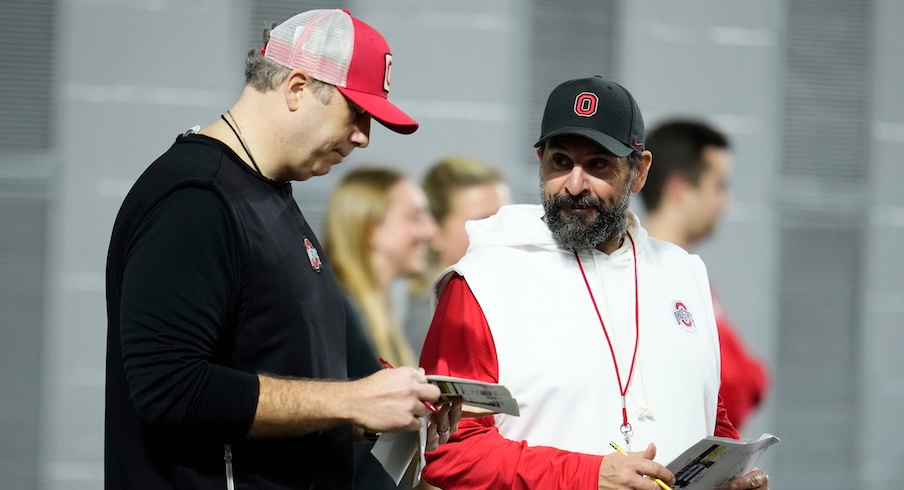
Day’s staff of assistant coaches for the 2026 season is led by a pair of former NFL head coaches in offensive coordinator Arthur Smith and defensive coordinator Matt Patricia. Ohio State’s coaching staff is also bigger than it’s ever been before, as the Buckeyes expanded their full-time assistant coaching staff from 10 coaches to 12 this offseason, allowing them to have a dedicated offensive, defensive and special teams coordinator (Robby Discher) in addition to position coaches for every unit.
That wouldn’t have been possible without a significant financial investment from Ohio State, which will pay its assistant coaches $15.3 million, an increase of more than $3.5 million from last year and the largest assistant coaching budget ever for a college football program (in addition to the $12.5 million Day will make in 2026). But Day believes that investment will pay major dividends for the Buckeyes both on the field and on the recruiting trail.
“If I'm a recruit and I come in and I have Arthur Smith on offense and Matt Patricia on defense, I know I'm going to get coached like an NFL team, like an NFL organization,” Day said Tuesday. “If you come to watch practice like a lot of recruits did today, or you guys got a chance to see some of that, it's an NFL practice right there … for guys who want to look at the long-term goals and where they want to be in five to 10 to 20 years down the road, I think it gives us an edge, because of our history, what we've done, and the type of people that's in the building.”
Smith, who replaced Brian Hartline as Ohio State’s offensive coordinator following Hartline’s departure to become the new head coach at South Florida, is the third former NFL head coach Day has hired to be a coordinator in the last three years (four if you include Bill O’Brien’s brief stint as offensive coordinator before becoming the head coach at Boston College in 2024). So far, the track record of former NFL head coaches as Ohio State coordinators has been fantastic: Chip Kelly helped lead Ohio State to a national championship in his lone season as the Buckeyes’ offensive coordinator in 2024, while Patricia’s defense was the nation’s best last season in his first year as Ohio State’s defensive coordinator in 2025.
Day sees great value in having former NFL head coaches as coordinators, citing their ability to lead the coaching staffs on their respective sides of the ball as well as their experience coaching at the highest level of the sport.
“When you come with that perspective, we always say you learn so much when you take on a new role. And I think the managing of their staffs on their side of the ball is critically important,” Day said. “You’re seeing Matt do that now with some of the staff hires and changes that we're making on his side of the ball, and then as Arthur’s starting to install some of the things that he has done in the past, there’s a system in place for it. And it's not the NFL, but it's pretty close. The hashmarks are different. The guys are a little bit different. But there's a lot of things that carry over here.”
“If I'm a recruit and I come in and I have Arthur Smith on offense and Matt Patricia on defense, I know I'm going to get coached like an NFL team, like an NFL organization.” – Ryan Day on the value of having former NFL head coaches as coordinators
Another key change that makes this year’s coaching staff more NFL-like is that Ohio State also hired Cortez Hankton (who joins linebackers coach James Laurinaitis as former NFL players on Ohio State’s 2026 coaching staff) to replace Hartline as wide receivers coach. That means every player on offense and defense will have a coach who focuses specifically on coaching their position group without doubling as an offensive or defensive play caller, and it allows each coach to focus more directly on their specific responsibilities, both on the field and in recruiting.
The expansion of the coaching staff was made possible by a rule change in the summer of 2024 that removed the limit on the number of coaches who can provide on-field instruction in practices and games. Despite that change, Ohio State – and most other college football programs – chose to stick with just 10 full-time assistant coaches in 2025, though it hired more analysts and quality control coaches to its support staff. This year, however, Day and Ohio State athletic director Ross Bjork collectively decided that hiring two more coaches with full salaries was worth the investment.
“We now have Cortez coaching the wide receivers, but we also have Arthur as the offensive coordinator, so it's a plus one there. And that was a change. And so that's a little bit more like an NFL operation, just in terms of how we structured that,” Day said. “And I got to give Ross and the (Board of Trustees) credit for allowing us to do that – because that was a whole other position – and knowing how important that is.”
The impact of not having an experienced play caller leading the offense was evident last season, as Ohio State’s offense took a step back – even with a quarterback who completed 77% of his passing attempts – with Hartline leading the offense as a first-time play caller. It didn’t help that USF hired Hartline before the Big Ten Championship Game, forcing Hartline to split duties between two jobs (and Day ultimately taking over play calling for the Cotton Bowl loss to Miami) ahead of Ohio State’s two toughest games of the year, but Day and Bjork both felt it was important for Ohio State to have a “head coach of the offense” so that Day could focus on overseeing the entire program rather than spending most of his time with one side of the ball.
“It really came down to, given the magnitude of what's happening with the transfer portal, with NIL, with roster construction, with all the moving parts in college athletics, being the CEO of the program is probably more paramount than it's ever been before,” Bjork told Eleven Warriors in February. “And so what Coach Day and I talked about was we have a head coach of the defense in Matt Patricia, clearly, right? He's got command of that side of the ball. How can we find somebody who has the experience, who has the chops, who understands play calling at this level that can really be the head coach of the offense?
“Coach Day's always going to have his fingerprints on the offense. He's never going to step completely away. But there's going to be some days where he just can't be in the film room all day because he's dealing with running the program or dealing with other issues or representing the program in the community. Those things happen as well. So how can you find somebody who can really be the head coach of the offense to really allow him to be that CEO coach, even more so than it ever has been before? And so that's what we talked about. Given the flexibility of coaching staffs now, where there's not coaching limits anymore; yeah, you have your 10 designated off-campus recruiters, but technically, anybody who's in that building can be a coach. And so we looked at it and said, ‘OK, how do we structure this the right way?’”
Day said Tuesday that Smith will not be one of Ohio State’s 10 coaches who travels for recruiting, at least not initially, though Day is hopeful that future rule changes will allow Ohio State to change who its 10 designated recruiters are over the course of the year. Patricia will remain one of Ohio State’s 10 designated recruiters alongside the nine position coaches, Day said.
Coaching staff construction isn’t the only way Day’s Ohio State program is increasingly resembling an NFL team. Thanks to NIL and the transfer portal, Ohio State’s roster-building approach is also becoming more comparable to the NFL. Ohio State now has a de facto salary cap as it determines how to most effectively use its allotted revenue-sharing money to add and retain players, and the Buckeyes utilized this year’s transfer market like free agency more than they ever have before, bringing in 17 scholarship transfers – most of whom are upperclassmen that the Buckeyes expected to play substantial roles in 2026.
That was by design, as Day felt the Buckeyes needed to be older and more experienced – a key component of the Indiana and Miami teams that beat Ohio State and played in the national championship game last season – than they were in 2025.
“When you see guys who were going to be seniors walk out the door,” Day said, citing the NFL draft departures of Caleb Downs, Arvell Reese, Carnell Tate and Kayden McDonald, “the first thing you've got to do is you've got to get some more veteran guys in that room, or else you're just constantly young. I felt like we were a little young (in 2025), quite honest. And so when you go through it and you get some more senior guys in there, it's just a different approach. And we felt like we needed that.”
Day has made it clear that he doesn’t want his program to be exactly like an NFL organization. Drawing the specific distinction that college teams recruit players while NFL teams draft, Day wants recruiting and development to remain the lifeblood of the Buckeyes, and he wants stricter rules around college football that are actually enforced to protect the recruiting and development of players. But as Ohio State continues to adapt to the new era of college football – one in which players are paid and can change teams every year, and in which teams must win at least three College Football Playoff games to win a national championship – Day and the Buckeyes are embracing the sport’s growing similarities to the NFL and building their program accordingly, starting with the coaching staff.
“We're trying to build an identity that carries throughout the entire season. And when you have somebody like Arthur who's been through it before, he's been through playoff games, he's played a long season in the NFL, you have to kind of build towards the end of the season. And that's the goal here for us,” Day said. “Because when you think about the way things are structured now, I mean, you've got to be building towards the end of the season.
“Now, (in 2026), with some of the games that we play, I mean, you've got to start right from the jump on it, too. And you've got to play throughout the length of the season. And I think it's an opportunity for us to continue to get stronger throughout the season, get challenged in certain areas, so that when it comes time to play in December and January, we're going to be salty, because we've been through the fire. And so having some experienced guys like (Smith and Patricia) running the offense and defense is going to be something that we count on to pay dividends in the end.”