The NCAA’s new five-year, age-based eligibility model could make a big impact on Ohio State’s 2027 football roster.
This year’s roster is unaffected by the change; all players who were out of eligibility after the 2025 season are still out of eligibility, and all players who were eligible for 2026 under the previous rules – including seventh-year seniors Ja’Kobi Jackson and Hunter Welcing – remain eligible. Looking forward to 2027, however, fourth-year seniors who would have exhausted their eligibility this season will have the opportunity to play another year of college football should they want to do so.
Players who already took a redshirt year – which will no longer exist under the new model – still have the same number of years of eligibility remaining as they did before last week’s rule change. Players who hadn’t taken a redshirt, however, now have a fifth year of eligibility at their disposal, while teams will no longer have to worry about limiting the number of games their freshmen play to preserve their fifth year of eligibility.
With that in mind, we’re taking a look at how much eligibility all of Ohio State’s 90 scholarship players have remaining under the newly simplified model and how that could impact Ohio State beyond this season. (Note: Players in bold now have an additional year of eligibility than they did under the NCAA’s previous five years to play four seasons model.)
Fifth (or Seventh) Year Seniors in Final Year of Eligibility (13)
QB Justyn Martin
RB Ja’Kobi Jackson
WR David Adolph
TE Bennett Christian
TE Hunter Welcing
C Carson Hinzman
OT Vasean Washington
DE Beau Atkinson
DE Kenyatta Jackson Jr.
S Earl Little Jr.
S Terry Moore
S Brenten “Inky” Jones
LS Dalton Riggs
All of these players have already taken redshirt years and are already in at least their fifth year out of high school, so all of them will exhaust their eligibility after the 2026 season.
One possible exception to the rule is Martin, who told Eleven Warriors in January that he expected to receive a sixth year of eligibility from the NCAA after missing the entire 2025 season with an injury. While hardship waivers for injuries will no longer be granted under the new model, Martin remains eligible to apply for a waiver until July 31 because his injury occurred before the new model was implemented.
Fourth-Year Seniors with Two Years of Eligibility (17)
WR Brandon Inniss
WR Devin McCuin
WR Kyle Parker
TE Mason Williams
OT Phillip Daniels
OT/G Austin Siereveld
G Luke Montgomery
G/C Joshua Padilla
DE Qua Russaw
DT Jason Moore
DT James Smith
DT Will Smith Jr.
DT John Walker
LB Christian Alliegro
CB Cam Calhoun
CB Jermaine Mathews Jr.
P Joe McGuire
Until last week’s rule change, seven players in this group had not redshirted and were in line to exhaust their eligibility in 2026: Inniss, McCuin, Williams, Montgomery, James Smith, Alliegro and Mathews. Now, each of those Buckeyes has the option to play another year of college football in 2027 if they want to.
Whether they actually will is another question. Montgomery and Mathews already weighed entering the NFL draft after last season before returning for another year, and all seven of them have the potential to be selected in next year’s draft if they perform well this fall. Siereveld, who already knew he still had two more years of eligibility because he redshirted his true freshman year at Ohio State in 2023, is another strong candidate to enter the 2027 NFL draft even though he’ll still have another year of eligibility, as he’s been projected as a potential early-round pick next spring.
Although McGuire is now older than the NCAA’s new age limit, having graduated from high school in 2018, he remains eligible to play two more years of college football because athletes who had already started their careers are able to use either the previous eligibility model or the new age-based model – whichever is more beneficial to them. McGuire is in his fourth year with the Buckeyes and redshirted his first year at Ohio State in 2023 before becoming the Buckeyes’ starting punter in 2024.
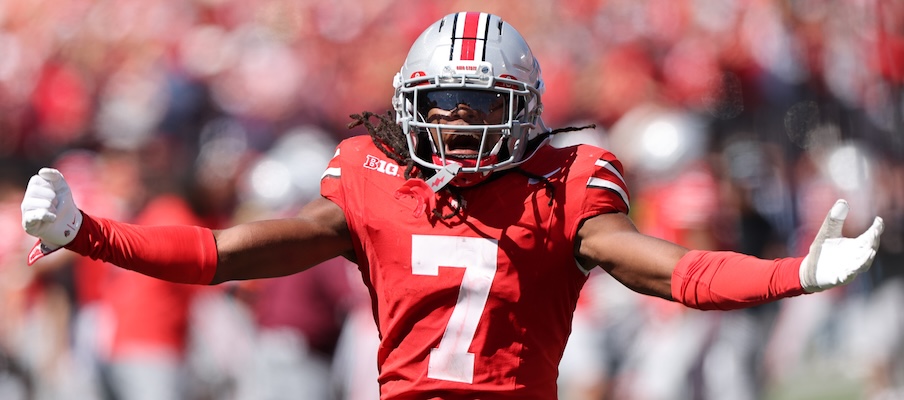
Jermaine Mathews Jr. now has a fifth year of eligibility, but he'll have a decision to make after this season on whether to use it.
Juniors with Three Years of Eligibility (13)
QB Julian Sayin
WR Jeremiah Smith
TE Max LeBlanc
OT Devontae Armstrong
OT Ian Moore
G Gabe VanSickle
DT Eddrick Houston
LB Payton Pierce
LB Garrett Stover
CB Miles Lockhart
S Jaylen McClain
S Leroy Roker III
K Connor Hawkins
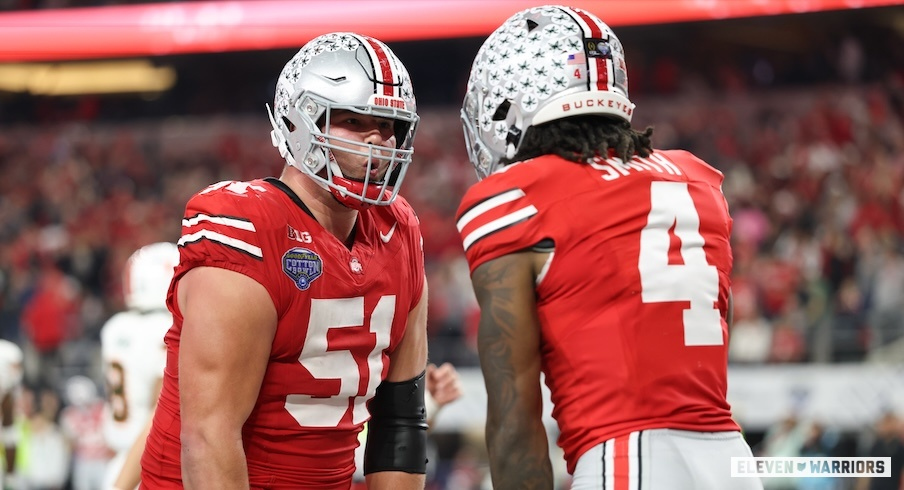
Three more years of Jeremiah Smith at Ohio State? It’s technically now a possibility, though even two more years of Smith in scarlet and gray is realistically a pipe dream for Buckeye fans, as Smith is projected to be the first non-quarterback selected in the 2027 NFL draft.
Other third-year Buckeyes who now have three more years of eligibility instead of two include Houston, Pierce and McClain, who didn’t redshirt as freshmen and are now in line to be three of Ohio State’s defensive stars as juniors. Any one of them could potentially go to the NFL after just one more year at Ohio State, let alone two, so the Buckeyes shouldn’t bank on having them on their 2028 roster, but they now at least know they won’t be punished for playing backup roles as freshmen should they desire to play five years of college football.
Sayin is another Buckeye on this list who will have an NFL decision to make after the upcoming season even though he already had three more years of eligibility, so it’s highly unlikely he’ll still be Ohio State’s starting quarterback in 2028. The rest of the Buckeye juniors are potential candidates to play three more years of college football, though Moore could emerge as an NFL draft prospect within the next two years if he wins one of Ohio State’s starting tackle jobs.
Sophomores with Four Years of Eligibility (19)
QB Tavien St. Clair
RB Bo Jackson
RB Anthony “Turbo” Rogers
RB Isaiah West
WR Phillip Bell
WR De’zie Jones
TE Brody Lennon
TE Nate Roberts
OT Carter Lowe
G/C Jake Cook
DE Zion Grady
DE Epi Sitanilei
LB TJ Alford
LB Eli Lee
LB Riley Pettijohn
CB Dominick Kelly
CB Devin Sanchez
CB Jordyn Woods
S DeShawn Stewart
Despite playing too many games to redshirt last season, Jackson, West, Roberts, Grady, Alford, Pettijohn, Kelly and Sanchez all now have four more years of eligibility along with the freshmen who did redshirt last year. Ohio State isn’t going to count on still having any of them on their 2029 roster – each of them has already flashed the potential to be an NFL draft prospect after just three or four years – but that option is now on the table for all of them.
Freshmen with Five Years of Eligibility (28)
QB Luke Fahey
RB Favour Akih
RB Legend Bey
WR Brock Boyd
WR Jerquaden Guilford
WR Chris Henry Jr.
WR Jaeden Ricketts
TE Nick Lautar
OT Sam Greer
OT/G Landry Brede
G Maxwell Riley
C/G Tucker Smith
C/G Mason Wilhelm
DE Darryus McKinley
DE Dre Quinn
DE Khary Wilder
DT Jamir Perez
DT Emanuel Ruffin
DT Damari Simeon
LB Cincere Johnson
LB Braxton Rembert
LB C.J. Sanna
CB Jordan Thomas
CB Jay Timmons
S Khmari Bing
S Blaine Bradford
S Simeon Caldwell
S Kaden Gebhardt
Calculating eligibility for Ohio State’s newest freshman class over the course of its career will be simpler than it’s ever been before. All 28 members of the Buckeyes’ 2026 class will now begin their careers with five years of eligibility instead of four, and all of them will still have four more years of eligibility next season no matter how much they play this season.
That allows the Buckeyes to play every freshman who earns a spot on the depth chart this season as much as they want without having to worry about redshirt implications. For players like Henry, Bey, Boyd and Timmons who already made a big push for playing time this spring, Ohio State wasn’t likely to worry about preserving redshirts anyway. But it could be a big benefit for freshmen who aren’t quite ready to play major roles yet but are good enough to earn backup jobs or special teams duty, as Ohio State will now be able to play those players in an unlimited number of games without having to worry about long-term eligibility implications.