It's been 51 years since Archie Griffin won his second Heisman Trophy.
That two-year run is still the only one of its kind, and it's what's still referred to whenever Archie's name is invoked. But the 1974 and 1975 seasons at Ohio State were also, in hindsight, the half-way point of his football career - nearly all of which was played in his home state.
Today we'll Remember When the last Ohio State running back to wear No.45 wasn't winning Heismans.
Archie was the middle brother in a family of seven boys who all grew up to play college sports. Oldest brother James Jr. played halfback at Muskingum. Larry was a fullback at Louisville. Daryle played defensive back at Kent State. Archie, Ray and Duncan all became Buckeyes, with Ray and Duncan playing in the secondary.
Baby sister Krystal ran track at Drake. All eight Griffin kids competed in college and graduated.
Archie made Eastmoor's varsity team as a sophomore in 1970 and quickly became one of Ohio's top high school players. His prep career culminated with Eastmoor's 1972 Columbus City League championship over Linden McKinley, where future world heavyweight champion James “Buster” Douglass would later star in both football and basketball.
Woody Hayes convinced him to stay home for college, and the Ohio State years became the defining chapter of Archie's career. It included a brief demotion to fifth string just before he set the freshman rushing record, a 3-0-1 record against Michigan, four Big Ten titles, four Rose Bowl starts and, of course, those two Heisman trophies.
It's easy to forget now, decades later, just how ubiquitous Archie was in the state during the mid-1970s. Ohio State football already operated as a statewide obsession under Woody Hayes, and Griffin's back-to-back Heismans elevated him beyond sports fame into something approaching civic identity.
In many parts of Ohio, he wasn't simply the best player on the best team. He was Ohio football.
Archie didn't even stay enrolled at Ohio State for a full four academic years, graduating a quarter early back when the university still operated on the quarter system. The Bengals selected him with the 24th overall pick in the 1976 NFL Draft.
He would be staying in the state. Eight years of playing in Ohio would continue just down I-71S.
April 8, 1976
— Bengal Jim & Friends (@bengaljims_BTR) April 8, 2026
OSU RB Archie Griffen gets his wish in the 1976 draft and stays home as the Bengals select him with the 24th pick in round 1.#CincinnatiFootballHistory
pic.twitter.com/Tp6ICNlALn
It was practically inevitable that his college career would overshadow what came after, but his NFL years were more substantial than they're often remembered today.
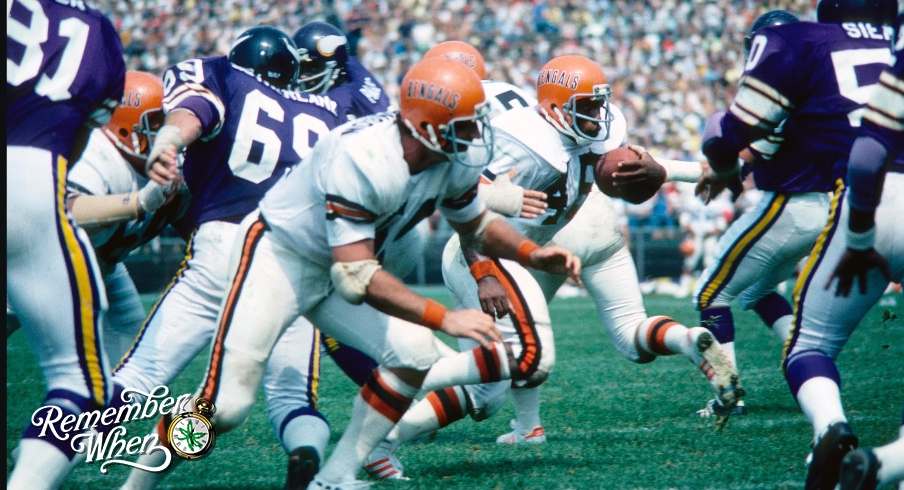
Archie played seven NFL seasons, all with the Bengals. For perspective, the average NFL career has been 3.3 seasons for decades. It's as brutal, punishing and immensely competitive sport, which makes that window for making it perpetually small. Griffin more than doubled the average - and he wasn't just hanging onto a roster spot.
When he retired in 1982, he ranked fourth in Bengals history in rushing. Forty-four years later, he still sits among the franchise's top 12 rushers. He was also the fifth-leading receiver, even as a tailback. Today, Griffin's 1,607 receiving yards ranks close behind incoming freshman Chris Henry Jr.'s late father, who is no.25 in Bengals history.
Even after his playing career ended, Archie never really left the public life of football in Ohio. Unlike many stars who eventually detach from the places that made them famous, Griffin remained visible in Columbus for decades through Ohio State, charity work, public appearances and eventually the university itself.
It's worth noting that while Developed Here™ has become a modern Ohio State mantra, Woody Hayes extracted an enormous workload from his best player in a pre-NIL era. Griffin still holds the program record with 924 carries. J.K. Dobbins ranks second with nearly 200 fewer attempts, essentially an entire season of football behind Archie.
Like many players whose professional careers never fully matched their talent, injuries played a role. Griffin was remarkably durable throughout his football life, but an Achilles injury in 1980 cost him his starting job and disrupted the momentum he had built in Cincinnati.
This video captures both the frustrations and successes of Archie's Bengals career.
By the end of his playing career, Griffin had accumulated nearly every level of football accomplishment available in Ohio: a high school championship, Big Ten titles, Rose Bowls, an AFC championship, a Super Bowl appearance and permanent status as a Columbus and college sports legend.
For 14 straight seasons, Ohio football fans watched Archie Griffin at every level of the sport, from City League championship games to Rose Bowls to the Super Bowl. The two Heismans became the headline, but they were not even close to being the entire story.