It's not too often that Ohio State plays football in a blizzard.
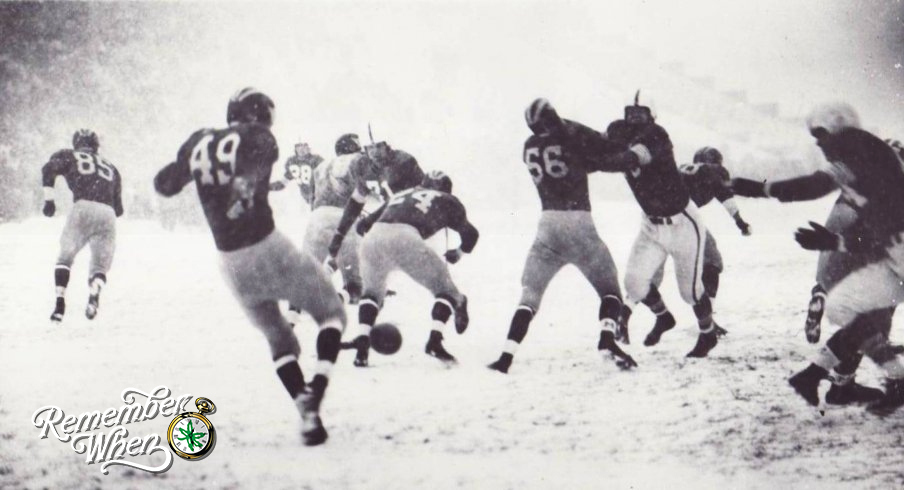
In fact, it's so rare that when the Buckeyes did so in The Game against Michigan on Nov. 25, 1950, it was considered the Snow Bowl. Seventy-six years later, that name still holds.
The weather was expected. The game could have been postponed to avoid the conditions, but Ohio State athletic director Dick Larkins and coach Wes Fesler decided to proceed as planned after consulting with Michigan and Big Ten officials. Fesler and Michigan coach Bennie Oosterbaan didn't want to play the game, but the Wolverines said that they would forfeit the game – and not postpone it – if it wasn't played, so the game went on as scheduled.
Ironically, if the game hadn't been played, the Buckeyes would have won the Big Ten and advanced to the Rose Bowl. But Larkins knew that if he decided not to play the game, he would never have "lived it down," according to the Ohio State University Monthly.
From start to finish, the 50,000-plus fans in attendance and Ohio State and Michigan players and coaches dealt with frigid temperatures, high winds and wind chill, and five inches of snow at kickoff, a number that only increased throughout the game.
“The game was played in the teeth of a full-scale blizzard, five inches of snow on the ground and snow whistling through the air, borne on a 29-mile-per-hour gale," an alum explained in the magazine. "Despite the fact it was the worst blizzard in 37 years in Columbus, the Ohio capital easily defended its title as the football craziest town in the nation. A total of 50,503 persons braved the elements, staying below deck, under the Stadium, until just a few minutes before the kickoff.”
Ohio State scored first after Bob Momsen recovered a blocked kick and Vic Janowicz made a 38-yard field goal of his own. Then, Michigan took a 9-3 lead into halftime after the Wolverines blocked a kick that rolled out of the end zone for a safety and blocked a punt that they recovered in the end zone for a touchdown.
In a game that was for the Big Ten championship, Michigan took down Ohio State, 9-3, in a matchup that will be remembered more for the weather and lack of what actually took place on the field than anything else.
How ugly was it, you ask?
Michigan didn't get a first down, had 27 total yards and punted 24 times while not completing a single pass. The Buckeyes, meanwhile, had three first downs, 34 total yards and punted 21 times. Some of those 45 punts came on first down, as Ohio State and the Wolverines thought it might be easier to score on defense rather than offense. The two teams combined for 10 fumbles as well.
| Time | Temperature (F) | Wind (mph) | Wind Chill (F) | Visibility (miles | Weather |
|---|---|---|---|---|---|
| Noon | 10 | 18 | -8 | 1/2 | Snow & Blowing Snow |
| 1 PM | 12 | 17 | -5 | 1/4 | Snow & Blowing Snow |
| 2 PM | 13 | 17 | -4 | 1/3 | Snow & Blowing Snow |
| 3 PM | 14 | 22 | -4 | 1/2 | Snow & Blowing Snow |
| 4 PM | 16 | 20 | -1 | 1/4 | Snow & Blowing Snow |
“It was like a nightmare. My hands were numb (and blue)," Janowicz said after the game of the conditions. "I had no feeling in them and I don’t know how I hung onto the ball. It was terrible. You knew what you wanted to do, but you couldn’t do it.”
The magazine tried to explain the game in its own way.
“The snow, wind, and insecure footing made the game a mockery – an imitation of football only by a stretch of the imagination. The two teams huffed, puffed, bumped and slid. Cold hands refused to hang on to the ball. At the end of 60 minutes of sliding and kicking, Michigan emerged on the long end of a 9-3 count.
“Volunteers were detailed to special broom duty, keeping the goal lines and the sideline yard-markers swept clean throughout the game. On several occasions, when there was an official’s time-out to measure for a first down, a special crew of sweepers cleared off the snow to find the line.
“The strategy of both teams became the same: run a play or two into the line – straight in – and then kick, preferably on third down, because if a fumble occurred, a fourth down for kicking would be available.”
The Snow Bowl was Fesler's fourth straight loss to Michigan (he never beat TTUN), and he resigned 18 days after that gam. Woody Hayes replaced him in Columbus that offseason.