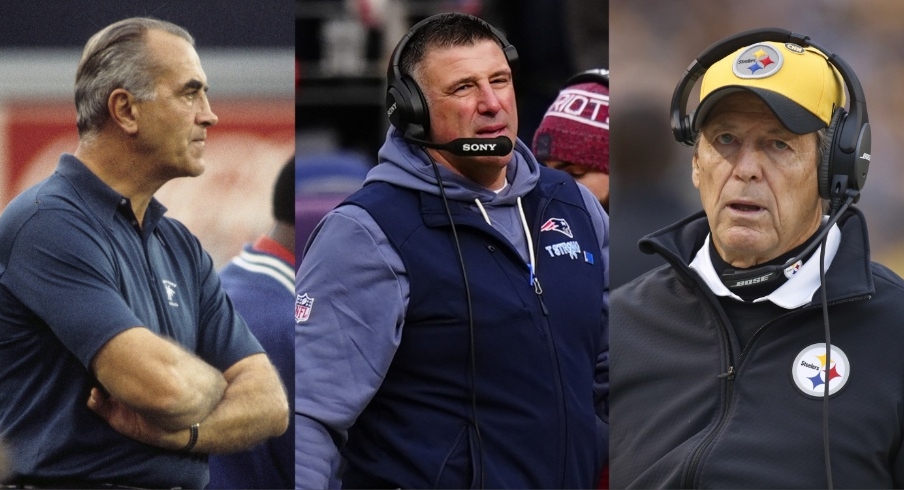
What Mike Vrabel’s done this season as head coach of the New England Patriots is nothing short of immaculate.
Fired after six years as the Tennessee Titans’ head coach at the end of the 2023 season, Vrabel arrived to a Patriots squad that went 4-13 in both 2023 and 2024, the former season their last under Bill Belichick and the latter their only under Jerod Mayo. Vrabel immediately took them from one of the league’s worst teams to potentially its best. A 14-3 regular season saw the emergence of Drake Maye as a new franchise quarterback, with New England boasting a top-five scoring offense and defense.
Defense won the day in each of the Patriots’ first three playoff games under their defensive-minded Buckeye alumnus head coach. They beat the Chargers 16-3, the Texans 28-16 and the Broncos 10-7 to reach Super Bowl LX this Sunday. Vrabel already has three Super Bowl rings from his playing career with the Patriots, but reaching one and trying to win it as a coach brings entirely new challenges.
As Vrabel prepares to coach the biggest game of his life, he joins a select and elite group of Ohio State alumni to coach in the Super Bowl. Only one other Buckeye alumnus, Don McCafferty, has led a team to a Super Bowl as a head coach. One more, Dick LeBeau, did it three times as a coordinator. Pro Football Hall of Famer Sid Gillman has an AFL championship to his name with the 1963 San Diego Chargers, but no other Buckeye alumnus has reached the Big Game as the leader of a team, offense or defense.
Today, we’re taking a look back at the championship journeys of McCafferty and LeBeau as Vrabel prepares to join this small Buckeye fraternity.
Don McCafferty
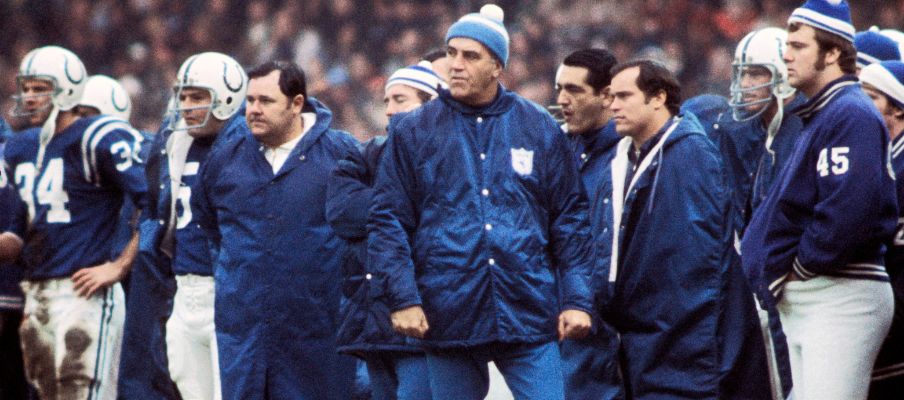
Dick Raphael – Imagn Images
McCafferty achieved incredible heights in a tragically short football life.
He played offensive tackle for Ohio State’s first national championship team in 1942, receiving second-team All-American honors under the legendary Paul Brown. His college career was cut short when he joined the U.S. Army in 1943, serving his country in World War II.
The New York Giants drafted McCafferty in the 13th round of that year’s NFL draft, and he joined the team three years later at the conclusion of his military service. His professional playing career lasted just one season. He was destined for higher heights as a coach than a player at that level.
McCafferty spent 11 years as an assistant coach at Kent State before being called back to the NFL in 1959 as the offensive backs coach for the Baltimore Colts. Those backs included a 26-year-old quarterback and first-team All-Pro Johnny Unitas, who won the NFL MVP in his first year being coached by McCafferty. Despite his military background, McCafferty brought a light-hearted approach to coaching, foreign to many of the famous disciplinarians of the time, including the legendary soon-to-be Colts head coach Don Shula.
Unitas biographer Tom Callahan recounted one of Unitas’ first interactions with McCafferty in his book on the Pro Football Hall of Famer, “Johnny U”:
“John, do you want any help on Sunday?” McCafferty asked sometime after he arrived in 1959.
“Mac, if you’re positive they’re going to blitz, let me know. Otherwise, sit back, relax and enjoy the game.”
Baltimore repeated as NFL champions in 1959. The trust between Unitas and McCafferty – and the mesh of Shula and McCafferty’s contrasting coaching styles – was not lost on the Colts’ head coach, who promoted McCafferty to be his offensive coordinator in 1963. Baltimore ranked in the top three in the league for scoring four out of five seasons from 1964 through 1968, making it to the NFL Championship Game in 1964 and Super Bowl III in 1968, but losing both.
Then, the Miami Dolphins made Shula a sweetheart deal that included a 10% ownership stake in 1970, and he jumped at the opportunity. Baltimore promoted McCafferty to head coach, a popular choice with Unitas and the Colts’ locker room, which dubbed him “Easy Rider.”
“He doesn't shout and scream. He's able to look at football objectively without getting carried away emotionally.”– Johnny Unitas on Don McCafferty
Baltimore rolled to an 11-2-1 record and a pair of multiple-possession victories in its first two games of the playoffs. Then it played in perhaps the most chaotic and sloppy Super Bowl of all time, Super Bowl V, (highlights here, since the NFL is the No Fun League and doesn't allow YouTube embeds on other websites) against the Dallas Cowboys. It earned nicknames such as the “Blunder Bowl,” “Blooper Bowl” and “Stupor Bowl.”
The Colts committed seven turnovers as the Cowboys added four for a Super Bowl-record 11 total. Unitas sustained an injury in the second quarter that knocked him out of the game, but not before throwing a 75-yard touchdown pass tipped twice before landing in the hands of Hall of Fame tight end John Mackey. The ensuing extra point was blocked. Dallas took a 13-6 lead into the fourth quarter, only to throw an interception that set Baltimore up 3 yards away from the end zone, and a 2-yard plunge tied the game at 13. The pick was one of five fourth-quarter turnovers in the game.
With less than two minutes to play, a 2nd-and-35 pass from Cowboys quarterback Craig Morton slipped through the hands of receiver Dan Reeves and into the arms of linebacker Mike Curtis, who returned it 13 yards to the Dallas 28-yard line. Two plays later, rookie kicker Jim O’Brien booted through a 32-yard game-winning field goal.
Unitas and the legendary Colts of that era finally had their Super Bowl in a 16-13 win. McCafferty is one of just two rookie NFL head coaches ever to win a Super Bowl, joining George Seifert of the San Francisco 49ers, who followed another legend in Bill Walsh in 1989.
McCafferty led Baltimore back to the AFC Championship Game in 1971, but after a 1-4 start to his 1972 season, management insisted he bench the then-39-year-old Unitas. He refused and was fired, the fastest a Super Bowl-winning head coach has ever been fired after his championship.
The Detroit Lions hired McCafferty as their head coach in 1973 and went 6-7-1 his first year. But during preparations for the 1974 season, while mowing his lawn at his home in West Bloomfield, Michigan, McCafferty suffered a fatal heart attack. He died at just 53 years old.
Dick LeBeau
Kevin Whitlock/Massillon Independent/USA TODAY NETWORK via Imagn Images
Both Ohio State’s Super Bowl-winning head coach and coordinator won a national championship with the Buckeyes. LeBeau won his natty with the Buckeyes in 1957, then embarked on a Hall of Fame career as an NFL player, racking up 62 interceptions in a 14-year career with the Detroit Lions as one of the premier cornerbacks of his day. He was inducted into Canton in 2010.
LeBeau began his coaching career at the NFL level as Philadelphia’s special teams coach in 1973, but bounced around for a few decades before finding the role that made him a defensive play-calling legend. His first defensive coordinator role came with the Cincinnati Bengals in 1984, where he lasted eight years before being fired in 1991 after a pair of awful defensive seasons.
He rebuilt his reputation as Pittsburgh’s defensive backs coach from 1992 through 1994, then as its defensive coordinator in 1995 and 1996, so the Bengals hired him again as DC and assistant head coach in 1997. In 2000, LeBeau became Cincinnati’s head coach. A combined record of 12-33 in three years led to his second sacking from the franchise.
One year as an assistant head coach in Buffalo finally led LeBeau back to Pittsburgh as defensive coordinator in 2004. There, he became the architect of some of the greatest defenses in modern NFL history. In 11 years with the Steelers, four of LeBeau’s defenses ranked No. 1 in the league for scoring.
Pittsburgh won Super Bowl XL in LeBeau’s second year under then-head coach Bill Cowher, the legendary franchise’s first championship since Super Bowl XIV in the 1979 season. After earning a wildcard berth, the Steelers upset three straight opponents on the road before pulling one final 21-10 upset over the NFC’s No. 1 seed, the Seattle Seahawks, to take home the Lombardi Trophy.
The Steelers’ 2008 Super Bowl season lives as LeBeau’s masterpiece, however. Hall of Fame safety Troy Polamalu and linebacker James Harrison, that season’s AP Defensive Player of the Year, fueled a defense that finished No. 1 in scoring defense, total defense and passing defense. Pittsburgh allowed a meager 237.1 yards per game to opposing offenses. The next-best defense in the NFL that year, Baltimore, featured two Hall of Famers (Ray Lewis and Ed Reed) and still finished well behind at 261.1 yards allowed per game.
That new-age Steel Curtain smothered said Ravens in the AFC Championship Game, surrendering just 198 yards of total offense en route to a 23-14 victory. But the NFC champion Arizona Cardinals had Hall of Fame talents at quarterback (Kurt Warner) and wide receiver (Larry Fitzgerald) and plans other than being shut down by a vaunted Pittsburgh defense.
Harrison made one of the most iconic defensive plays in Super Bowl history to close the first half, a 100-yard pick-six as time expired that put the Steelers up 17-7 when it appeared they might go down 14-10 entering the locker room.
February 1st, 2009: James Harrison makes the INT right before halftime & returns it 100-yards for the TD vs Arizona in Super Bowl XLIII #SuperBowl #HereWeGo pic.twitter.com/Nr8fUzzktW
— Back Then Sports (@BackThenSports) February 1, 2026
That lead expanded to 20-7 late in the third quarter. Undeterred, Arizona capped a then-record 13-point Super Bowl comeback to take a 23-20 lead on a 64-yard bomb from Warner to Fitzgerald.
But LeBeau’s second Super Bowl win, and the first for then-head coach Mike Tomlin, was sealed by another former Buckeye. With 35 seconds left, a toe-tapping touchdown by wide receiver Santonio Holmes put Pittsburgh up 27-23, the game’s final score.
SUPER BOWL XLIII
— Kevin Gallagher (@KevG163) February 1, 2026
February 1, 2009
Big Ben to Santonio
Ben Roethlisberger hits Santonio Holmes for the last-minute game-winner to secure the #Steelers' sixth ring.#HereWeGo pic.twitter.com/VMxsVu78U9
LeBeau made a third Super Bowl as the Steelers’ defensive coordinator to cap the 2010 season, but Pittsburgh lost to Green Bay, 31-25. LeBeau resigned as DC following a disappointing 2014 campaign for his defense, then spent three years coordinating for the Tennessee Titans before his retirement in 2017.
The head coach the Titans hired the following season? Mike Vrabel. Time is a flat circle.