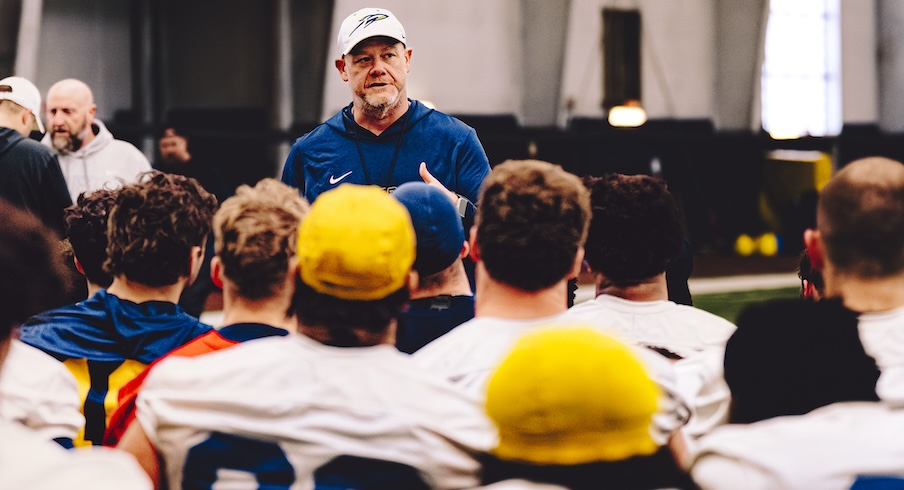
Mike Jacobs’ entire life has helped lead him to his new job as Toledo’s head coach.
When Jacobs was born in 1979, his father, also named Mike Jacobs, was the offensive line coach at Toledo. While his father left Toledo for West Virginia the following year, Jacobs returned to Northwest Ohio as a second-grader after his parents divorced. After growing up in the Toledo suburb of Maumee and graduating from Maumee High School, Jacobs played for Ohio State – where his father was offensive coordinator and offensive line coach – as an offensive lineman and long snapper, learning more about coaching from John Cooper and Jim Tressel along the way.
From there, Jacobs started his coaching career as a graduate assistant at Eastern Michigan, ultimately becoming a head coach for the first time at Notre Dame College in 2016. After four years as the head coach there, another four years as a Division II head coach at Lenoir-Rhyne and two years as a FCS head coach at Mercer, Jacobs is now an FBS coach for the first time at Toledo, which hired him in December after Jason Candle left to become the head coach at UConn.
There’s no other place where Jacobs would rather be an FBS coach for the first time.
“I’m home, man. I grew up right here in Toledo so it's been really special to have my family back here in town and be around a bunch of family and friends,” Jacobs told Eleven Warriors. “To be the head coach at the place that I grew up in, to do it at a place that, I mean, the coaching category that has come from here is unbelievable, right? I mean, you're talking about Nick Saban, you're talking about Gary Pinkel, you're talking about Matt Campbell, certainly Jason with what he's done, there's some people that have had tremendous amount of success.
“And what's special about this place is it's not just University of Toledo graduates; the city of Toledo really backs it, whether they're alumni or not, and I think that's been maybe the most eye-opening thing for me that you really don't realize as a casual fan or when you're just kind of growing up here. You knew people supported it but that has really been the big piece for me as I've taken this job on.”
Twenty-five years after playing for the Buckeyes, Jacobs is part of a rapidly growing fraternity of former Ohio State players who are now FBS head coaches. Jacobs is now one of seven Ohio State graduates who are FBS head coaches – the most of any school – joining Bowling Green’s Eddie George, Notre Dame’s Marcus Freeman, Wisconsin’s Luke Fickell, South Florida’s Brian Hartline, Northern Illinois’ Rob Harley and Auburn’s Alex Golesh (who did not play for Ohio State, but was an undergraduate student assistant for the Buckeyes).
| Alma Mater | No. | Coaches |
|---|---|---|
| Ohio State | 7 | Luke Fickell (Wisconsin), Marcus Freeman (Notre Dame), Eddie George (Bowling Green), Alex Golesh (Auburn), Rob Harley (Northern Illinois), Brian Hartline (South Florida), Mike Jacobs (Toledo) |
| Texas Tech | 5 | Sonny Cumbie (Louisiana Tech), Sonny Dykes (TCU), Zach Kittley (Florida Atlantic), Eric Morris (Oklahoma State), Lincoln Riley (USC) |
| Arkansas | 3 | Alex Mortensen (UAB), Rhett Lashlee (SMU), Dowell Loggains (Appalachian State) |
| BYU | 3 | Steve Sarkisian (Texas), Kalani Sitake (BYU), Kyle Whittingham (Michigan) |
| Mount Union | 3 | Matt Campbell (Penn State), Jason Candle (UConn), Jay Sawvel (Wyoming) |
| Note: This list counts each coach’s alma mater as the school where they finished their playing careers and/or earned their bachelor’s degrees. | ||
Comparing himself to the other Buckeyes who have gone on to become head coaches, Jacobs knows his Ohio State career didn’t reach the same heights of the likes of George, Fickell, Freeman and Hartline. A walk-on to start his Ohio State career, Jacobs played in 38 games for the Buckeyes but made only one start, which came in the final game of his career at the end of the 2001 season when LeCharles Bentley missed the Outback Bowl due to a shoulder injury.
That said, Jacobs’ five years as a Buckeye were invaluable to his journey into coaching, as he learned lessons from Cooper and Tressel that helped shape him into the coach he is today. Jacobs always had interest in becoming a coach because he saw the way his father’s players looked up to him and the camaraderie of his teams, and he had the opportunity to learn more about coaching than the typical college football player would because of his father.
“I had a very unique and inside perspective because three of my five years, the first three years I was on the roster – ’97, ’98, ’99 – my dad was my position coach as well as the offensive coordinator,” Jacobs said. “But leading up to that, you know, I got to be around those guys. And the curtain was back a little bit. And John Cooper's a Hall of Famer. I watched my dad be around Don Nehlen for 15 years at West Virginia, he's in the Hall of Fame. And then I got to see Coach Coop do it and recruit at such a high level. And then, albeit short, but my last year was spent with Jim Tressel, another Hall of Famer.
“So you go back-to-back-to-back (College Football) Hall of Famers and you just take it all in and you watch how they function, what they do. More by osmosis; it wasn't like I was necessarily gunning that early to be a head coach. But you certainly watch things and how they were ran, how they were organized and with Tress, most importantly, how he treated people. And those things ultimately led to the foundation of what I've tried to build as I've become a head coach.”
Specifically, Jacobs says he learned a lot from Cooper about how to manage a roster and from Tressel about how to connect with players and everyone else in his program.
“John recruited at an extremely high level, and to manage and balance the amount of talent that was on that roster and the ego and some of those things that go into it, I thought Coop did a great job with all of that stuff,” Jacobs said. “And then, again, from Coach Tress, the unique and just completely uncommon ability to connect with people. There's still nobody better. He just instantly draws everybody in that he remembers. His ability to recall very specific details about everyone, and how he treated everyone in the building, whether they were walk-ons, whether they were stars, whether they were the janitor or the coordinator, he just connected with people and was able to make strong connections, and I think that's more important than maybe anything now.”
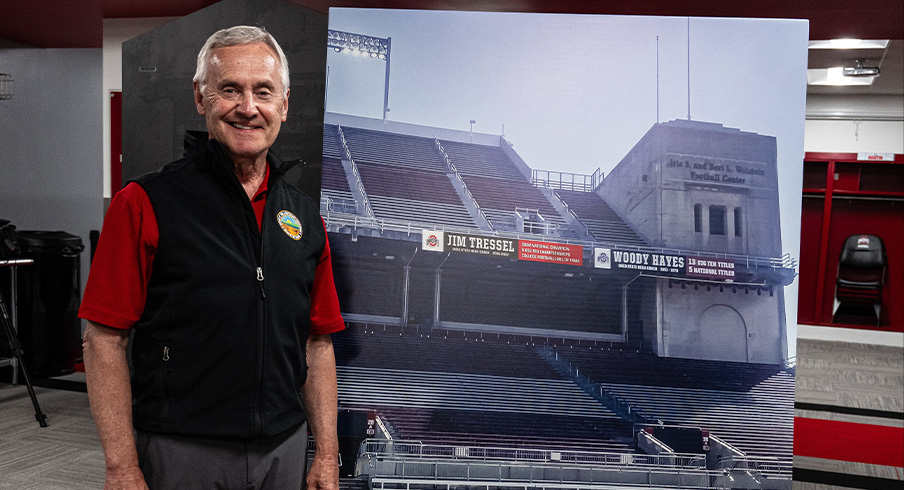
Owing to their shared roots as Buckeyes, Jacobs says two of his closest connections in the head coaching ranks are Fickell and Golesh. While their own time as Ohio State students didn’t overlap with Jacobs, Fickell was a graduate assistant at Ohio State during Jacobs’ career, while Jacobs and Golesh became friends through their mutual connections at OSU.
“Luke Fickell has always been very good to me,” Jacobs said. “Luke has always been somebody that's been willing to pick up the phone, and whether I've been looking for young assistant coaches or just needed to talk to somebody, Luke's always been very good to me.
“And then I speak to Alex Golesh a ton. … He and I just had a bunch of very similar and common friends as we were coming up (in the coaching ranks), even though we were never at Ohio State simultaneously. And I've always respected Alex and how he's worked really hard to get to where he's at.”
One former Buckeye whom Jacobs will see plenty of in his new role is George, as Bowling Green is Toledo’s rival. Jacobs says he doesn’t know George well, as George’s Ohio State career concluded before Jacobs’ began, though the elder Mike Jacobs was Ohio State’s offensive coordinator for George’s Heisman-winning season in 1995. That said, Jacobs says he has a lot of respect for George even though he’ll be looking to beat George in the Battle of I-75.
“I respect the fact that he took a Tennessee State team that hadn't won a ton and turned it into a really consistent winner and a playoff team in a very competitive FCS conference, and he's doing some things at Bowling Green to get them back on the right track,” Jacobs said. “I think it's cool to have two Buckeyes leading two very prominent programs, two people that understand certainly what a significant rivalry means.
“I don't know that our football careers could look any different,” Jacobs added, laughing. “As far as playing, we're obviously on opposite ends of the spectrum. But a ton of respect for Eddie and all that he's accomplished, both as a player and now what he's beginning to do as a coach.”
Jacobs may not have become a household name during his playing career at Ohio State, but he’s now one of many examples of the Ohio State football program developing successful coaches. And especially now that he’s back in the Buckeye State, he knows his past as a Buckeye carries weight as he recruits and builds relationships in the coaching ranks.
“I think the combination of being an Ohio State guy, a ton of familiarity with my father, who was well-respected amongst the high school ranks in the state, and then my grandfather was a high school coach for 50 years here, he's in the Ohio High School Hall of Fame,” Jacobs said of how his Buckeye roots help him as a football coach in Ohio. “And so there's a lot of moments for us and a lot of people, and it's just like anything, you gotta do a great job with the relationship piece with those high school coaches.”