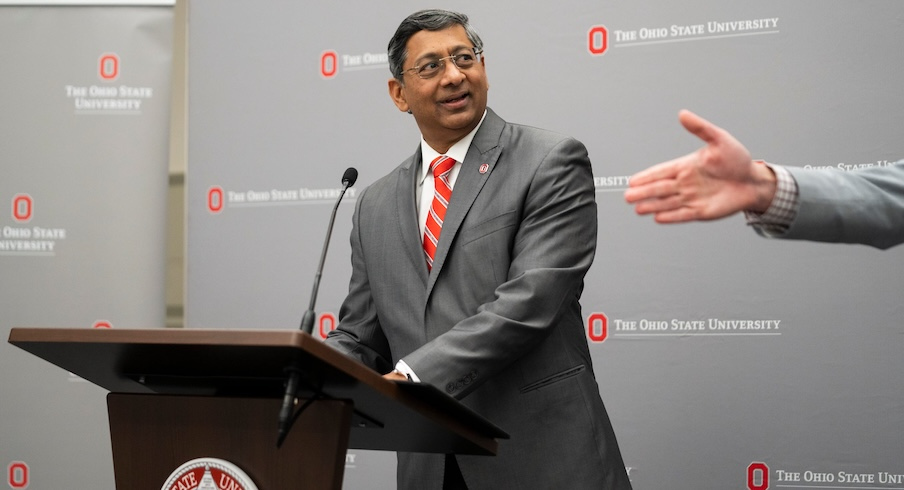
Ohio State’s Ravi Bellamkonda was among four Big Ten presidents who met with a group of U.S. Senators on Tuesday as the push for national college sports legislation continues.
Bellamkonda, Michigan president Domenico Grasso, Penn State president Neeli Bendapudi and USC president Beong-Soo Kim met Tuesday with a group of seven U.S. Senators – Ted Cruz and Maria Cantwell, the authors of the Protect College Sports Act, as well as Ohio’s Jon Husted and Bernie Moreno, Michigan’s Gary Peters and Elissa Slotkin and Pennsylvania’s John Fetterman – to “work toward a national legislative solution that serves student-athletes, provides regulatory certainty, and maintains America’s long tradition of exceptional collegiate athletics.”
A joint statement released by Ohio State, Michigan, Penn State and USC described the meetings as “very productive.”
The presidents of Michigan, Penn State, Ohio State and USC had very productive meetings today with legislative partners as we work toward a national legislative solution that serves student-athletes, provides regulatory certainty, and maintains America’s long tradition of exceptional collegiate athletics.
We appreciate the effort behind the Protect College Sports Act and support the bill’s intent. At the same time, key issues should be addressed to ensure the bill protects student-athletes and provides long-term stability for colleges, universities and conferences. We support the priorities previously outlined by the Big Ten Conference, including an NIL and revenue-sharing framework that is workable, enforceable and fair to student-athletes, and liability protection and preemption of state law that is sufficiently clear and brings an end to the nonstop litigation and fragmentation that is eroding the educational mission of college sports and making fair competition impossible.
In addition, colleges and universities are differently situated and have always retained flexibility over conference membership, sponsored sports, scholarships, scheduling, and media rights. Preserving this flexibility will enhance universities’ ability to offer broad-based sports programs, support Olympic sports, and safeguard the student-athlete experience.
We look forward to continuing conversations with the bill sponsors and other legislative partners as we pursue our shared goal of a strong, sustainable national legislative solution for all sports, conferences and divisions.
The Protect College Sports Act, introduced by Cruz and Cantwell in late May, is a bipartisan college sports bill that would grant the NCAA a limited antitrust exemption that would allow it to enforce rules around transfers and eligibility without facing challenges from state and local courts. The Senate is expected to vote on the bill before its recess in early August.
That said, the current framework of the bill has faced opposition from both the Big Ten and SEC. Specifically, the Big Ten and SEC are opposed to provisions in the bill that would allow FBS schools to pool their media rights if 75% or more of FBS institutions vote in favor of a joint agreement, as well as prohibiting the Power 4 conferences from expanding. The conferences have also expressed concerns that the bill “leaves critical issues unresolved.”
“It does not meaningfully preempt the patchwork of state laws or provide the protections needed to make and enforce consistent rules, both essential to long-term stability in college athletics. It also shifts ongoing rulemaking to Congress, limiting the ability to adapt quickly as the landscape evolves,” the Big Ten and SEC said in a joint statement in June. “Rather than reducing litigation, the bill likely expands it without offering clear alternatives for dispute resolution. Finally, the bill alters the House settlement revenue sharing framework in a way that may result in fewer student-athletes receiving direct revenue share payments.
Yahoo Sports’ Ross Dellenger reported after Tuesday’s meeting that “there is movement from lawmakers to make some of the revisions to the bill that SEC and Big Ten leadership requested,” but it is “unclear if these possible changes – not yet formalized in legislation – will be enough to garner support from the two leagues.”
Reminder: In accordance with Eleven Warriors’ commenting policy, we request that all comments refrain from political discussion that does not directly relate to college sports and the proposed legislation.