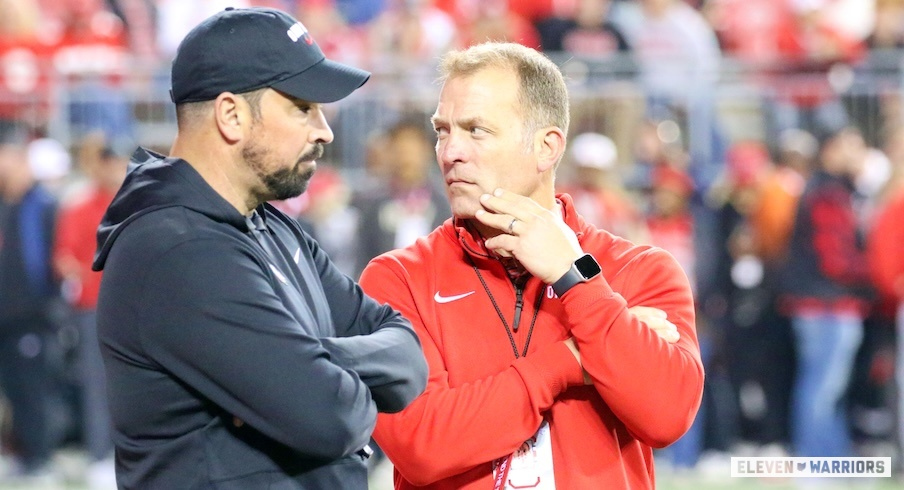
You can count Ohio State athletic director Ross Bjork among the many people involved in college football who believe the sport’s calendar needs to change.
Thanks to the new 15-day January transfer portal window that was implemented for college football this year, the entirety of this year’s transfer portal window took place while the College Football Playoff was still ongoing. That led to a chaotic month for everyone in the sport. Ohio State lost a wave of players to the portal just hours after its season-ending loss to Miami in the College Football Playoff quarterfinals, while the teams that made the CFP semifinals and final had to work on building their rosters for the 2026 season while still trying to win a national championship for the 2025 season.
Bjork believes there should be a clear separation between the actual season where games are played and the roster-building season where players can change teams via the transfer portal.
“We should play the games during this period, and we should build the roster during (a separate) period,” Bjork told Eleven Warriors. “Right now, we co-mingle those on top of each other, and no other industry, no other sport does that. Now you're constantly recruiting, you're constantly building relationships, but now, we are in a transactional environment, and we're coupling the transaction piece on top of when we play. And to me, that's way too disruptive. I don't care if you're in the playoffs or not. It's way too disruptive to our coaches, to their livelihood, to the rhythm of any sort of offseason.”
The overlap between the season and the transfer portal could be solved by ending the season earlier, opening the portal later or a combination of both. Bjork is in favor of the latter.
Regarding the season itself, Bjork believes the College Football Playoff should end in December or early January, not late January as it currently does. Bjork, who is in favor of another round of CFP expansion, believes the season can end earlier even if the playoff expands.
Bjork thinks the season should start in late August every year, consisting of a 12-game regular season with two bye weeks. He also believes the time between CFP games should be shortened, allowing the season to end earlier than the current structure, in which next season’s national championship game will be played on Jan. 25, 2027, nearly two months after the final day of the regular season (Nov. 28, 2026).
“There's no reason we should be playing that late,” Bjork said. “So how can we work with the TV partners? How can we work with the NFL? And how can we really maybe own the whole month of December, where that whole month of December is college football? And maybe it bleeds in a little bit into the new year, but I think there's a way to condense it.
“I think players want to play. They want to play. Give them the right weeks off during the season, but then just play, because then you get in a rhythm and you get confidence as you go along. And I think we could do this in a much healthier manner than what we're doing now.”
Bjork, who says he’d be in favor of expanding the CFP to anywhere from 16 to 24 teams, believes conference championship games should be eliminated if the playoff expands to any more than 16 teams.
“I think it depends on the number of playoff teams, frankly. I think if you go to 16, you can maybe keep your conference championship games. I think if you expand beyond that, then they probably have to fade away,” Bjork said. “Because you're playing more games, obviously. You're probably playing well into December with that model.”
“There's no reason we should be playing that late.”– Ross Bjork on ending the college football season in late January
As for the transfer portal, options could include moving the portal window back to February or as far as the end of the spring semester in April or May. Bjork believes opening the portal at the end of the spring would be best. It would align most closely with athletes’ revenue-sharing contracts, which run from July to June, while Bjork believes it could also lead to higher player retention rates.
“We need to figure out a different window for the portal period. There's been some discussion about, do you move it to February or do you move it to maybe April or May? I'm in the camp of moving it to later in the spring,” Bjork said. “One, it takes the ability to kind of have a reset and a deep breath after the season. It gives you a chance to, maybe there's guys that are sort of on the fence of whether they want to come back or not, but then you can work them out, you can train them, maybe you can have some sort of spring practice schedule and then you can give them a true evaluation. ‘Hey, you might want to leave because your opportunity here is not going to be there,’ or ‘Hey man, you had a great spring and you're ready to roll and you're going to have a spot here.’”
The downside of moving the transfer portal window to the end of the spring is that teams would not have their full rosters in place until the time when spring practices are currently held. Bjork says he’s heard opposition from some college football coaches that they don’t want to have players on their spring rosters who are already planning to leave at the end of spring, but Bjork believes that’s the wrong way of looking at it.
“I've heard coaches talk about, ‘Well, I don't want to have a portal in April because then I'm going to have to babysit for the whole semester with guys that may not want to be here.’ Well, if we're actually doing this the right way, it's not babysitting,” Bjork said. “It's actually communicating. It's working together. It's maybe training them. It's actually maybe developing them into a better player. Or maybe they don't leave, they stay.”
Ohio State coach Ryan Day has said several times that he also believes the transfer portal window should be held in the spring, even though he acknowledged it is a plus to have the entire roster in place for this year’s winter workouts and spring practices.
“I wasn't for, I was pretty outspoken about it, about having the portal open up one time here in the winter. I don't understand any of it … I've got a lot of phone calls saying ‘You were right,’” Day said during a Jan. 30 edition of The Ryan Day Show. “That's not making me feel any better. But one thing that is good about it is now that the portal is closed, we kind of know what our team is, and we have almost all of them here for the spring season, which is great.”
If the transfer portal window is eventually moved to the middle or end of spring semester, spring practices could ultimately be replaced by offseason team activities that begin in May or June after players have transferred to their new schools.
“I get that the coaches want to have their roster set as early as possible in January, so then you can have spring practice. Well, let's get rid of spring practice the way it is now. Let's have some summer access, some summer OTAs, whatever you want to call it, that would alleviate some of that pressure,” Bjork said.
| Event | Current | Proposed Change |
|---|---|---|
| Week 1 of Season | Labor Day Weekend | Last Weekend of August |
| End of CFP | Late January (Jan. 25 in 2026-27) | Late December or Early January |
| Transfer Portal | Early January (Jan. 2-16 in 2026) | End of Spring (April or May) |
| Spring Practices | March-April | May-June |
If and when the college football calendar will be revamped remains uncertain. Calendar changes reportedly weren’t discussed during last month’s American Football Coaches Association Convention, prompting frustration from many coaches.
Sources tell @On3 that calendar changes were not discussed. A lot of frustration on that one. https://t.co/Tr96tvvvIX
— Pete Nakos (@PeteNakos) January 13, 2026
The current structure of how college football is governed contributes to the messy nature of the calendar. While the NCAA still governs the sport from a rules perspective, the College Football Playoff is a separate entity from the NCAA while the newly formed College Sports Commission oversees revenue sharing. Competing interests among schools and conferences also lead to policies that lack common sense.
That said, Bjork believes it shouldn’t be hard to build a college football calendar that makes sense for everyone if leaders around the sport can come together to hash it out.
“Fixing the calendar in our industry is actually not that hard. It's really not that hard to figure out. We can sit down in an afternoon, the three of us could, and we could map it out,” Bjork said while speaking to Eleven Warriors’ Chase Brown and me. “The problem is the closer you get to the competitive nature, everybody has their perspective. Everybody has a perspective that says, ‘No, for us, it's better this way,’ or for this league or this conference, it's better this way.
“To me, we could fix this easy, but we get territorial, we get competitive, and then that complicates things. So to me, we should just separate roster building from playing. And if we use that as the fundamental basis, I think we could come up with a way better method to figure this out than what we do now.”