2025 was not the year Ohio State expected on the offensive side of the football. Not in the games that mattered, anyway, outside of The Game, which always matters.
The Buckeyes throttled Michigan 27-9 in Ann Arbor through a layer of snow, utilizing timely passing and a physical run game that took over in the second half. It inspired confidence in an offensive line and backfield that had been great in pass protection all year, but struggled to run the ball against any defense with a pulse. False confidence, with the hindsight of the two games Ohio State played to close its season afterward.
Pass protection imploded in the Big Ten Championship Game vs. Indiana and the College Football Playoff quarterfinals vs. Miami. Run game struggles re-emerged. Play-calling, not even something being evaluated in this story, was questionable.
As a result, the grades on Ohio State’s final offensive report card are a mixed bag. Receivers? Going to grade out well, obviously. Offensive line? Not so much. The Buckeyes return many of the same offensive pieces in 2026, so there are clear areas to address moving into next year. But also some positives to take away despite how the season ended – though those two games factored heaviest into the grading scale here. Let’s dive in.
Quarterback
Grade: A-
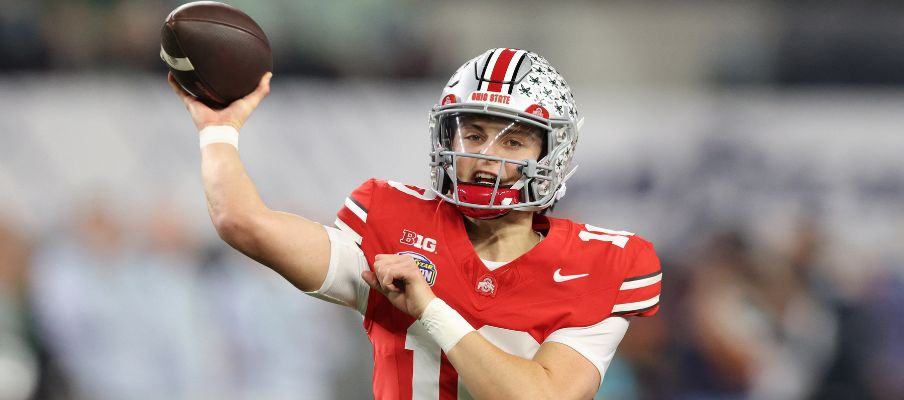
I deliberated between B+ and A- as Ohio State’s quarterback grade, which is really just a grade of Julian Sayin. The heavy weight of the Indiana and Miami games in these marks, arguably Sayin’s two worst performances of the season (also against the two best defenses he faced), was almost enough to knock the Heisman Trophy finalist down below the A-grade range. But he wasn’t awful in those two games, and removing them, he’d get an A+.
Sayin came out as a redshirt freshman first-year starter and set the world on fire in the 2025 regular season. He posted the best regular-season completion percentage in NCAA history at 78.4%, finishing the year No. 1 in the country at 77%, just .4% away from the overall single-season record set by Oregon’s Bo Nix (77.4%) in 2023. He led the nation in passer rating through the regular season at 182.1.
But those matchups with the Hoosiers and Hurricanes exposed flaws in Sayin’s game that he’ll work to address this offseason. He threw first-half interceptions against Michigan, Indiana and Miami, the latter for a pick-six that put The U ahead 14-0 when Ohio State looked primed to tie the game at seven or at least make it 7-3. Perhaps related to his shorter stature, he didn’t see potential open receivers over the middle or up the seams like slot receiver Brandon Inniss or tight end Max Klare in those contests. Like in this play, where Klare is standing in the end zone with no defenders in the same county:
— Random Ohio State Play Every Day (@OSUPlayEveryDay) January 1, 2026
Sayin took 10 sacks combined against Indiana and Miami, too, which goes on the performance of Ohio State’s pass protection, mostly, but also falls somewhat on his shoulders. There were chances to get the ball out quicker. The elite pocket presence that he showed throughout the regular season vanished in those games. Per Pro Football Focus, when under pressure vs. the Hoosiers and Hurricanes, Sayin went an abysmal 8-of-19 (42.1%) for 93 yards (4.9 yards per attempt) with no touchdowns and an interception. When under pressure in the regular season, he finished 45-of-71 (63.4%) for 634 yards (8.9 yards per attempt) and seven touchdowns with just two interceptions. And he took just seven sacks in those 12 games.
But on the whole, Sayin did still go 43-of-64 (67.2%) for 545 yards and two touchdowns – with three interceptions – against Indiana and Miami, and his season statline as a first-year starter was ridiculous. A 77% completion rate with 3,610 yards and 32 touchdowns with just eight interceptions. He was a Heisman Trophy finalist and the Shaun Alexander Freshman of the Year. It’s enough to hold onto an A-, at least in the eyes of this grader.
Running Back
Grade: B-
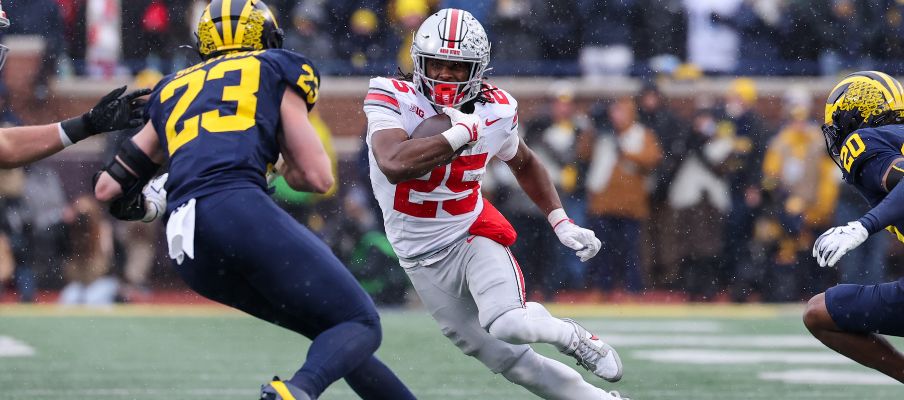
Ohio State’s run game struggled for much of the 2025 season, aside from its incredible performance in Ann Arbor. The Buckeyes’ offensive line and perimeter blockers take blame for that, but so do their running backs – as exciting as the future of the room looks.
The then-well-regarded tandem of CJ Donaldson and James Peoples came out as Ohio State’s co-featured running backs in the season-opener vs. No. 1 Texas, but neither shone in that game or in several of the ones that followed. The Buckeyes’ defense and a big passing play or two carried them to a 14-7 win over the Longhorns. On the ground, they picked up just 77 yards in 34 carries, a meager average of 2.3 yards per carry.
Then Bo Jackson, a freshman, rattled off back-to-back 100-yard games against Grambling State and Ohio. The competition may have been weaker, but Jackson looked a step quicker and more elusive than Peoples or Donaldson. When Ohio State hit the road to Washington the following game, Jackson emerged as the team’s No. 1 back, carrying the ball 17 times for 80 yards, eight more carries than any other back received. He stayed atop the rotation thereafter.
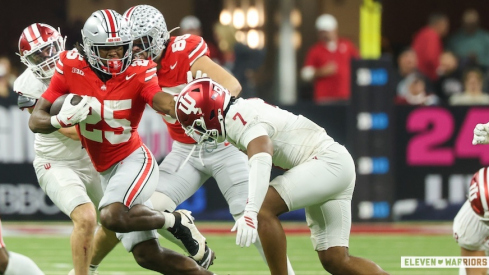
Jackson finished the season with 179 carries for 1,090 yards and six touchdowns, adding 200 receiving yards and a receiving score. He had a legacy moment early in his career by becoming the latest Ohio State freshman to have a big game against Michigan, joining former stars like Chris Olave and Garrett Wilson. Jackson racked up 117 rushing yards on 22 carries against the Wolverines and added another four receptions for 49 yards for 166 total yards from scrimmage. It’s still a mystery how this turned into a 36-yard run.
No way Michigan fans are talking badly about Bo Jackson https://t.co/N3qsXF7cb1 pic.twitter.com/iZk0LU80jj
— THE Bunch of Nuts Podcast (@bunch_nuts) January 8, 2026
But Jackson didn’t make as many men miss against Miami. He also got blown up in pass pro, resulting in a sack of Sayin in that game. Illinois and Wisconsin also largely hemmed him in. Per Pro Football Focus, he averaged 4.1 yards after contact, a great number that led Ohio State’s backs in 2025. But he only averaged 2.5 yards after contact vs. the Hurricanes. Like Sayin, there’s room for a leap next year, which should be an encouraging thought for Buckeye fans.
After transferring from West Virginia to spend his senior year at Ohio State, Donaldson finished as the Buckeyes’ No. 2 back in terms of carries, with 96 for 361 yards and 10 touchdowns. That’s only 3.8 yards per carry, but his primary use was as a short-yardage back. Then again, Ohio State had notable short-yardage struggles in 2025. He had a solid performance against Miami, especially in the second half, finishing with seven carries for 31 yards and five receptions for another 31 yards. He also proved dependable in pass pro.
Freshman Isaiah West had several games where he got the second-most carries for Ohio State after Jackson, but the Buckeyes turned back to Donaldson as back No. 2 against the Hurricanes. Still, West flashed, especially during his nine-carry, 55-yard day at Wisconsin and against the maligned run defenses of Purdue, UCLA and Rutgers. He finished the year with 59 carries for 310 yards (5.3 per carry) and two touchdowns.
Last among the Buckeyes’ four major backfield contributors was Peoples, who had 61 carries for 334 yards and three touchdowns. There were parts of the year he looked like a capable contributor, then others where he showed a lack of vision at the position. He’ll play for Penn State next year.
Wide Receiver
Grade: A-
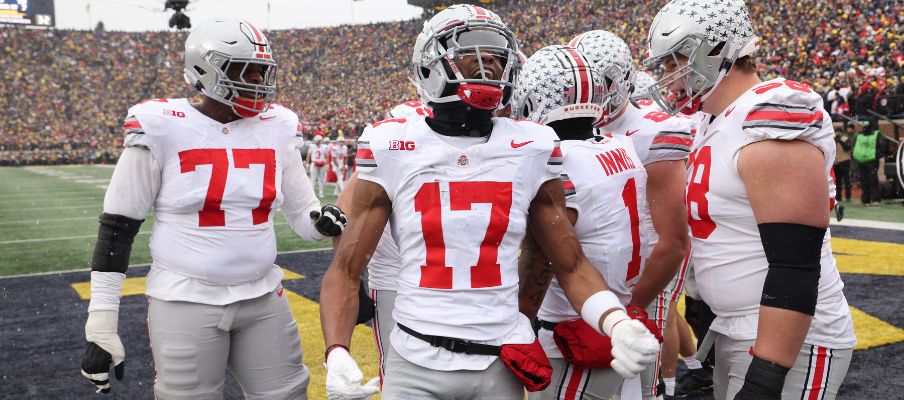
Wide receiver, inarguably, was Ohio State’s best offensive position group in 2025. Jeremiah Smith and Carnell Tate, when healthy, were an A+. The only things that drag the group down are a lack of production at slot receiver and a lack of depth.
The superstar Smith followed his breakout freshman campaign with a sophomore season featuring 87 receptions for 1,243 yards and 12 touchdowns. He was a finalist for the Biletnikoff Award, given annually to the nation’s best pass catcher, and a unanimous All-American. With one year remaining before he likely declares for the NFL draft, Smith is likely to set each of Ohio State’s career school records in the big three receiving stats; he needs just 43 more receptions, 341 yards and nine touchdowns to set each career mark in Columbus.
Tate took a step from a steady No. 3 wide receiver for Ohio State’s 2024 national championship team to a no-doubt first-round NFL draft pick and second-team All-American as Smith’s partner in crime in 2025. Playing just 11 games due to injury, he hauled in 51 receptions for 875 yards and nine touchdowns, making some of the most difficult catches possible look easy. Well, except for perhaps the best catch of the Buckeyes’ season against Wisconsin.
This is just a my guy is better than your two guys throw.
— Dane Brugler (@dpbrugler) October 18, 2025
Carnell Tate, man. pic.twitter.com/cZR6VCS4WS
Oh, and Tate is an All-American in the classroom, too.
Now for the rest of the room. There were more opportunities to get Brandon Inniss the ball than his stat line showed, and he played a vital leadership role as a team captain, but the five-star prospect’s junior season didn’t live up to his expectations. He finished with just 36 receptions for 273 yards and three touchdowns. Advertised as a potential third explosive weapon, he averaged just 7.5 yards per reception, with Sayin’s occasional blind spots noted.
Also falling short of their advertised performance were the next wave of wideouts. Bryson Rodgers entered the season as a redshirt sophomore with a bit of experience. Mylan Graham, a five-star prospect, came into his second year off a massive spring game performance. Five-star freshman Quincy Porter drew attention.
None of them emerged as a dependable fourth option, despite there being three games where Tate was out with injury. In one of those games, Ohio State’s penultimate regular-season game against Rutgers, Tate and Smith were both out. The Buckeyes’ top-producing wide receiver that day? Former walk-on David Adolph, who had two receptions for 23 yards. He played the second-most snaps after Inniss, too, at 48.
It seems all the new responsibilities on Brian Hartline’s plate as play caller might have affected the development of the receivers lower on the Buckeyes’ depth chart. Each of Rodgers, Graham and Porter hit the transfer portal after the season. Of all the names mentioned in this section, only Smith, Inniss and Adolph return in 2026.
Offensive Line
Grade: C-
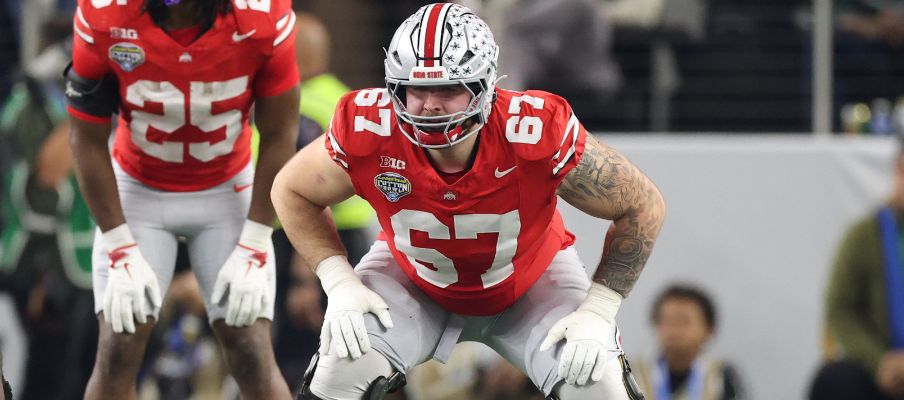
Cs might get degrees, but they’re nowhere near the Ohio State standard. The Buckeyes’ offensive line never gained consistent momentum in the ground game, and their season-long strength in pass blocking imploded in the final two games of the season.
Let’s start with the good. Austin Siereveld exceeded all expectations in his move from right guard to left tackle. He was the only of Ohio State’s five starting offensive linemen not to give up a sack in 2025, per Pro Football Focus. That’s in 425 pass-block reps, and he may have been better in run-blocking. PFF gave him an overall grade of 83 for the year, almost 10 points higher than the Buckeyes’ next-highest-graded offensive lineman, left guard Luke Montgomery (73.7).
In terms of the unit, the highlight of the season far and away came in Ann Arbor on Nov. 29. They took the very soul of Michigan’s program in the Big House, gouging its defensive front play after play to win the rushing battle and ice victory with an astounding 20-play, 12-minute second-half drive. And Sayin could have pitched a tent, built a fire and toasted a bag of marshmallows in the pocket.
Unfortunately, in the Big Ten title game and Cotton Bowl, the front allowed 10 combined sacks as Ohio State rushed for just 103 combined yards on 49 carries. That’s 2.1 yards per attempt.
Right guard remained a problem position all season, with Tegra Tshabola marred by inconsistency as he rotated with a revolving door of backups. Phillip Daniels brought a mauler’s mentality to right tackle, but that came alongside technical lapses. He allowed two sacks and 19 total pressures, per PFF, receiving an overall grade of just 65.9 from the service. Only Tshabola had a worse grade among the starting five (56.3).
Luke Montgomery earned second-team All-Big Ten honors at left guard, but that didn’t save him from struggles against Indiana and Miami, where he allowed a combined three sacks – his only three sacks allowed on the season. It’s a microcosm of the entire front five, which allowed a mere six sacks across its 12 regular-season games before the 10 it allowed in the postseason.
Center Carson Hinzman rounded out the starting five, grading out at a 73.6 on the season, the same number as Montgomery. The Buckeyes’ run game numbers on the season were not to the standard of the Scarlet and Gray; they finished 51st nationally in yards per carry (4.55) and 72nd in rushing yards per game (154.36).
Each of Siereveld, Montgomery, Hinzman and Daniels returned to Ohio State for the 2026 season. Perhaps another year of experience will result in a higher-graded season that ends better for the Slobs.
Tight End
Grade: B-
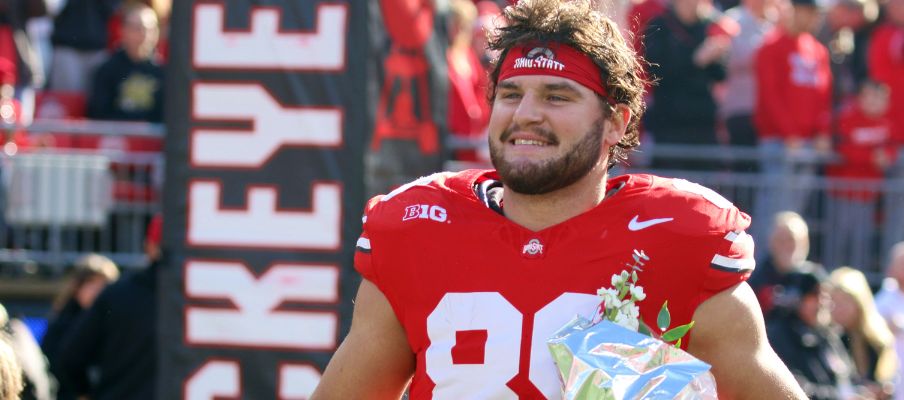
Many (including your dear writer of this story) claimed Ohio State entered 2025 with one of the best tight end rooms in the country. The output of the room did not match those expectations, but the Buckeyes’ line bookenders had a decent season.
Tight ends coach Keenan Bailey dubbed Will Kacmarek the “best blocking tight end in the country” before the campaign, and the former Ohio Bobcat often delivered in that area of his game. PFF gave him a grade of 71 as a run blocker, higher than both Daniels and Tshabola. Kacmarek allowed just two pressures and no sacks in 85 pass-blocking snaps. He added 15 receptions for 185 yards and two touchdowns in the receiving game.
Speaking of the receiving game, Max Klare had a strong statistical output as Ohio State’s top receiving option at the tight end position, albeit a step back from what he produced at Purdue in 2024. He collected 43 receptions for 448 yards and two touchdowns. But whether it was missed connections with Sayin or some other cause, he had zero catches against Miami and just two for 28 yards against Indiana. Texas also held him to one reception for 11 yards. He improved as a blocker as the year progressed, though.
The depth of the room was lacking in production, though, despite high numbers of snaps. Bennett Christian played 255 snaps as the No. 3 tight end on the depth chart, another blocking-first body. He didn’t grade out like it on PFF, though, receiving a run-blocking grade of 47.1 and an overall grade of 44.9. Still, he saw frequent work in multi-tight end packages focused on the running game.
Jelani Thurman was passed on the depth chart by freshman Nate Roberts before the year ended. Roberts flashed with four receptions for 40 yards.