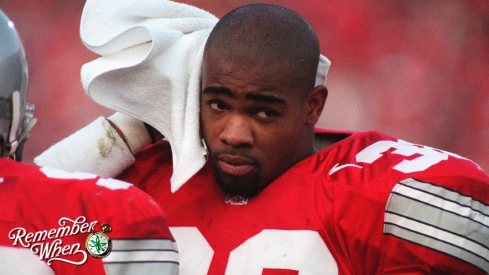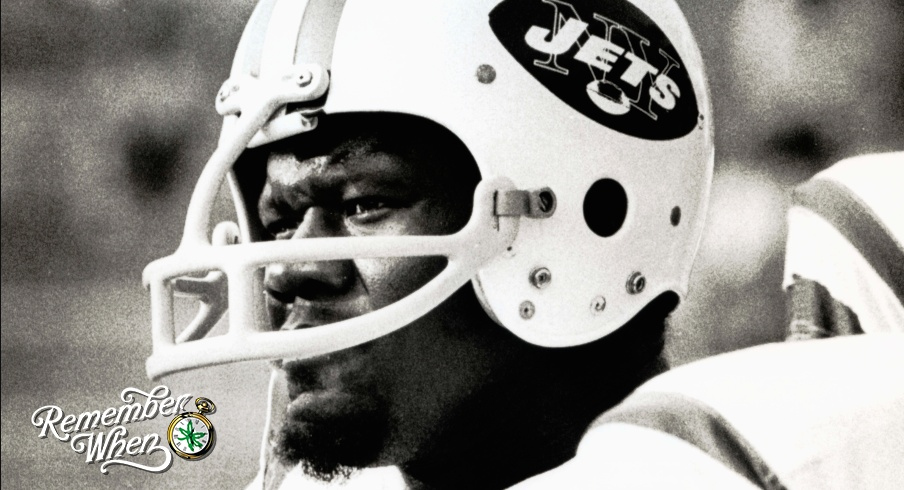
Former Ohio State fullback, star on both sides of the football and captain of the 1961 National Championship team Matt Snell passed away earlier this week in Long Island, NY at the age of 84. Snell had a decorated AFL career prior to the league's merger with the NFL in 1970, but his greatest achievement as a pro would be helping the New York Jets to what remains the franchise's only Super Bowl win in 1969. Incredibly, despite setting what stood at the time as the game's rushing record, Snell did not receive Super Bowl MVP honors, which instead went to the player with the much higher celebrity profile in Joe Namath.
The decision to award such a distinction to Namath over Snell seems worth exploring in wake of the look back at the latter's life taking place across football circles this week. Although Namath's series of bold proclamations prior to the game remains one of the all-time great delivered-upon callouts of an opponent in professional sports history, the clairvoyance realized in victory swept up those in charge of immortalizing the Super Bowl's greatest player that season. Thus, the episode serves as a tragic reminder over 50 years later of how great an impact a captivating narrative can have over substantive performance in the media's consideration of individual achievement recognition.
Before exploring the game itself, it's important to recall many factors surrounding the third installment of the Super Bowl relative to the outcome. As previously stated, this would be the final year prior to the AFL's merger with the NFL at the dawn of the next decade. While the Jets represented the former, the Baltimore Colts had spent the last two seasons running over the latter and almost any other obstacles in their path.
The Colts entered the Super Bowl in 1969 with a combined record of 24-2-3 over the previous two seasons and favored at sportsbooks during the time between anywhere from 17-19 points. In a modern American sports betting context, the NFL Champion Colts would have been the equivalent of a roughly -1400 favorite (93.3 percent implied probability of outcome) over the AFL Champion Jets going into the game.
Of course, that did not stop New York's Broadway Joe from running his mouth at his opponent leading up to the game. The Colts' previous decade of success had largely been built on the success of the legendary Johnny Unitas, but an injury-plagued season in the twilight of his career forced Baltimore to turn to backup Earl Morrall.
The new starter went on to win league MVP that season, but Namath remained unconvinced and unimpressed. Namath told the New York Times after the Jets clinched their spot in the Super Bowl that Morrall would not only not be a top-five quarterback in the AFL, but that Namath's backup Babe Parilli would operate the Colts' offense more effectively than Morrall.
"There are five quarterbacks in the AFL who are better than [Earl] Morrall.... You put Babe Parilli with Baltimore instead of Morrall and Baltimore might be better. Babe throws better than Morrall." — Joe Namath, 1969
Namath then traveled down to Miami during the week of the meeting with the Colts at the Orange Bowl. During an intoxicated public appearance at the Miami Touchdown Club, he confronted a boisterous Colts fan by declaring that, "we're gonna win the game, I guarantee it." A Miami Herald reporter at the event published Namath's prediction in an article and turned it into a major talking point ahead of the game, given the public's perception that the NFL was so much more obviously talented.
Taking into consideration the instances of comments from Namath against the backdrop of general consensus that the Colts would dominate is crucial to understanding how Snell failed to earn the recognition he deserved for ultimately leading the Jets to victory. Namath's seemingly fantastical prediction — which perhaps would have largely found itself forgotten had the Colts fulfilled most expectations and won — painted an intense amount of scrutiny on his performance. However, when he went on to play almost entirely mistake-free football in what proved to be a mostly one-sided domination of the opponent, that scrutiny flipped into adoring mythologization almost immediately.
In truth, Namath completed a fairly baseline 60 percent of his 28 passes for just over 200 passing yards and no touchdowns without recording a rushing attempt. Snell scored the first and only touchdown of the game for the Jets in the second quarter, then New York proceeded to build a 16-0 lead with three field goals into the closing stretch of the game.
Snell's longest rush on the day went for only 12 yards, but as a fullback noted for remarkable physicality that made him a standout in several duties and positions, he entered the game built to handle a championship-caliber workload. He ultimately ended the night with 121 yards on 30 carries. Over half a century later, Snell remains one of only six players in Super Bowl history to receive 30 or more rushing attempts in a single game (Eddie George fell two short in 2000 at Super Bowl XXXIV against the St. Louis Rams).
The rushing yards total would serve as the Super Bowl record for five more years until Larry Csonka broke it with 145 yards for the Miami Dolphins in 1974 at Super Bowl VIII. Snell finished the game with five more rushing yards than former Ohio State quarterback Tom Matte, whom converted to running back upon reaching the NFL and became a two-time pro bowler at the position — including for that season — before his team's letdown against the Jets. Matte coincidentally did set the Super Bowl total offensive yardage record in this same game with 146 rushing and receiving yards, but regardless of how the game ended, a former Buckeye would have walked out of Super Bowl III with the game's outright rushing record at the time.
Speaking of letdowns, perhaps the other side of what boosted Namath's mystic prowess was not just merely that he predicted his team would triumph in a massive upset, but that his counterpart would struggle immensely in the process. After an NFL MVP campaign during the regular season, Morrall proceeded to have one of the worst quarterback showings in Super Bowl history, throwing half as many interceptions (three) as he had completions (six) on just 17 passing attempts. The Colts eventually felt no other option but to bench him for Unitas, and while the sunsetting legend did help realize Baltimore's only touchdown drive late that day, he failed to account for any himself while tossing an interception of his own.
Namath's self-realization of such an improbably perceived result fully materialized in what became and remains the evening's iconic moment: Broadway Joe pointing to the sky triumphantly as he runs off the field into the stadium tunnel. The hysteria around his projections paired with a box score that lacked any obvious warts created a cruelly ironclad case for turning Super Bowl III's MVP vote into a popularity contest. Over 57 years later, Namath remains the only winner chosen by the media that failed to score any touchdowns or even points in a Super Bowl while actually winning the game.
Snell played one more full schedule for the Jets before retiring after the 1972 season due to disinterest in rehabbing what had become mounting injuries. The following year, he starred in Miller Lite's very first beer commercial.
In 2016, the NFL uploaded the entire two-hour and ten-minute broadcast of Super Bowl III to its YouTube channel for free viewing to the online public. The NFL Films Archive also offers a ~25 minute documentary about the game and events leading up to it on its own channel as well.