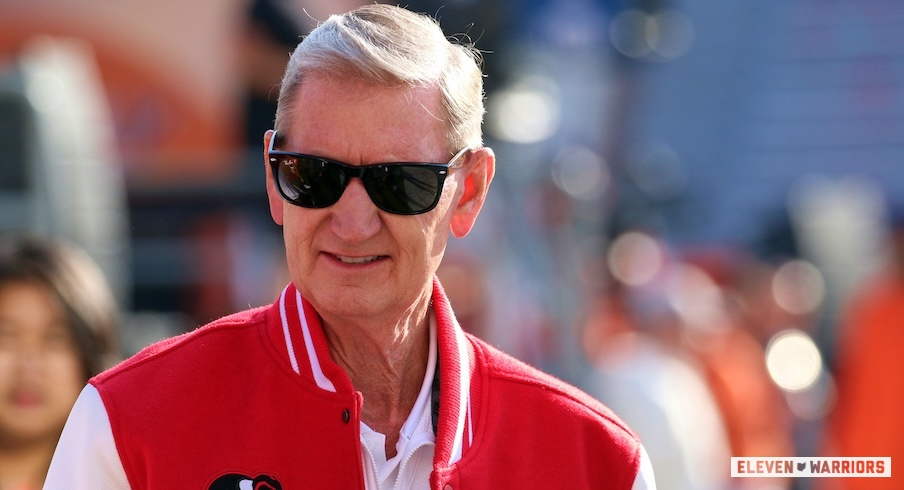
Ohio State president Ted Carter believes the NIL model in college sports needs to change sooner rather than later.
During an interview with 10TV’s Dom Tiberi earlier this week, Carter said he views the current model as unsustainable and thinks it needs to change within three years.
“I am worried. And I'll just say right up front, I'm not trying to make a headline: It's not sustainable,” Carter said. “If you look at the trajectory of when we started with the House v. NCAA (settlement) and where we've just gone in the last couple of years – yes, we’re moving them out of third party to more interior, we've got this College Sports Commission that's supposed to help vet all this – it is not sustainable over the next three years unless something changes.”
Under the structure created by the House v. NCAA settlement, which went into effect last year, schools are currently permitted to share $20.5 million in revenue with their athletes – a number that will increase to $21.3 million in 2026-27. But as schools are also now permitted to arrange name, image and likeness deals for their athletes that don’t come from direct revenue sharing, it’s been rumored that some schools and their boosters are paying their athletes significantly more than the revenue-sharing cap number.
The College Sports Commission, which was created last year to govern revenue sharing and NIL in college sports, is supposed to vet all NIL deals to ensure that they serve a valid business purpose rather than being used as recruiting inducements. But schools are continuing to find loopholes that allow them to pay players more, increasing the price tag for schools around the country to recruit and retain players.
Ohio State, which brought in a record-setting $336.1 million in athletics revenue during the 2025 fiscal year, is better-positioned than just about any other school to handle the rising costs of competing for national championships in college sports, particularly in college football. But as Ohio State remains committed to funding 36 sports, the most of any school in the nation, Carter views challenges on the horizon – for Ohio State and everyone else – if the model doesn’t change sooner than later.
“Ohio State is still competitive. There's only about five schools in the country that can play at this level right now in terms of NIL. Fortunately, we're one of them,” Carter said. “But even at that level, especially when we want to field a really good men's basketball team, a women's basketball team and compete in other sports like ice hockey, it's not sustainable. Something's going to have to give.”
Whether it comes from the NCAA, the conferences or the federal government, Carter believes there needs to be stronger guardrails around what schools are and aren’t allowed to do in terms of paying athletes.
“I think there's going to have to be some rules that are put up like bumper pads on the bowling alley to kind of make sure that you're not throwing the gutter ball. And that hasn't happened yet,” Carter said. “Whether it be at the NCAA level, whether it be the conference commissioners through the university presidents and chancellors getting together, or even legislation coming out of the government, something's going to have to accelerate this so before it gets too far out of control. Which some people would argue it already is now.”
“It is not sustainable over the next three years unless something changes.”– Ted Carter on the current NIL model in college sports
One potential change that Carter does not believe in, however, is making college athletes employees.
“I'm a big believer that we don't want to make our athletes employees because I think ultimately, they lose,” Carter said. “They lose things like scholarship. There'll be much less incentive to graduate and get a degree, which is something that we hold dear. They could lose medical care after they leave a program. So I just see more downside to becoming an employee or becoming unionized than the upside. And then depending on states and employee rules, you might have to actually apply for some of these positions. So, you know, be careful what you wish for. The second, third order effects are not going to be what you like.”
Carter said he wouldn’t be surprised if the federal government gets involved in regulating college sports. Ohio State athletic director Ross Bjork expressed support for federal college sports legislation in an interview with Eleven Warriors last week, citing state and local lawsuits that have prevented the NCAA from enforcing its rules regarding eligibility.
“We're being governed in the legal landscape right now. We're being governed in the courtroom. We're being governed in state-by-state NIL laws,” Bjork said. “Everybody keeps sort of criticizing the effort to go to Congress. But because of the state-by-state initiatives, because we're governed right now in the courtroom, the only place that can really codify this would be Congress, until we would reach a different maybe model.”
Whether leaders like Carter will succeed in their quest to rein in NIL spending remains uncertain, as schools have only become more and more aggressive in using NIL for recruiting since athletes were first allowed to be compensated for their name, image and likeness in 2021. But Carter believes creating a more sustainable model should be a top and urgent priority for college sports.
“I have a good feeling if you don't retire and I stay here for a few years, we'll still be talking about this in a couple of years,” Carter told Tiberi. “I think it will have to (be settled by then); I'd say two to three years.”