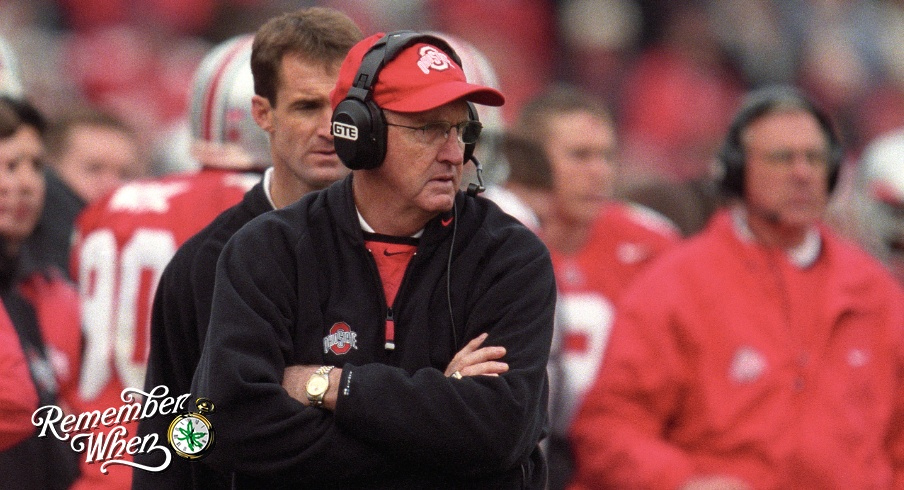
Heading into the 1999 season, the general sentiment around Columbus was that John Cooper had finally broken through as head coach of Ohio State.
The Buckeyes finished the 1998 season with an 11-1 record, including a rare victory over rival Michigan with Cooper at the helm, and ended the season at No. 2 in the AP Poll, behind national champions Tennessee. Ohio State had also enjoyed a second-place finish in 1996, and landed in the top 15 in each of the last six seasons heading into 1999.
Although Ohio State lost the strong arm of standout quarterback Joe Germaine, his favorite target in David Boston and several pieces from its stout defense — which held opponents to just 11.8 points per game in 1998 — the Buckeyes were still expected to have a contending 1999 campaign, slotting in at No. 9 in the preseason AP Poll.
Ohio State’s 1999 season began in unfamiliar territory, with the Buckeyes traveling to East Rutherford, New Jersey, to face No. 12 Miami in the Kickoff Classic at Giants Stadium.
Entering the 1999 season, the Hurricanes were eyeing a return to national prominence under head coach Butch Davis, who was brought in to revive Miami’s image after NCAA infractions ended years of contending, during which Miami secured four national titles from 1983 to 1991. Davis had lost at least three games in each of his first four seasons at Miami, including a lowly 5-6 mark in 1997.
But hopes were high for the Hurricanes in 1999. Miami entered the season at No. 12 in the preseason AP Poll following a 9-3 campaign in 1998, during which the Hurricanes won six of their last seven games.
With the Buckeyes aiming to continue their recent stretch of success under Cooper and Miami seeking a return to the national spotlight, plenty was on the line during that season-opening meeting in East Rutherford.
The Hurricanes jumped on the Buckeyes early, as a 44-yard touchdown run from running back James Jackson broke open the scoring with 11:44 to play in the first quarter. From there, Ohio State controlled the opening frame, tacking on a 23-yard field goal from Dan Stultz and a 6-yard touchdown connection from Austin Moherman to tight end Steve Wisniewski, to take a 9-7 lead into the second quarter.
While the 9-7 score held for much of the second stanza, Miami struck in a flash late in the quarter. Across a 3:06 span, the Hurricanes tacked on 16 points, thanks to the efforts of quarterback Kenny Kelly, who found paydirt on a 7-yard bootleg run, minutes before firing a 67-yard touchdown strike to wideout Santana Moss with eight seconds remaining in the half to give Miami a 23-9 lead heading into halftime.
Ohio State’s offense gave Miami little resistance in the second half, adding just a 24-yard field goal off the foot of Stutlz in the third quarter, while the Hurricanes used a long drive during the early stages of the fourth quarter to keep the Buckeyes at bay, securing a 23-12 victory over the Buckeyes at Giants Stadium.
It was a long day for Moherman, who completed 10 of 22 pass attempts for a measly 107 yards, a touchdown and two interceptions. While Moherman struggled, so did backup Steve Bellisari, who relieved Moherman during the second quarter. Bellisari saw an errant lateral cost the Buckeyes a potential field goal attempt, while also registering a lost fumble on Ohio State’s next drive.
Ohio State running back Michael Wiley started the game strong with a 69-yard jaunt in the first quarter, but finished the game with only 72 rushing yards on nine carries. In total, Ohio State managed just 220 yards of total offense.
The results of the Kickoff Classic sent both programs on wildly different trajectories.
Ohio State endured three seasons of mediocrity from that point forward, with Cooper leading the Buckeyes to a 6-6 record in 1999 and an 8-4 mark in 2000 before Ohio State ultimately moved on from the long-time coach in favor of legendary Youngstown State coach Jim Tressel. In his first season with the Buckeyes, Tressel pushed Ohio State to a 7-5 record, including an upset victory over No. 11 Michigan in Ann Arbor to end the regular season.
In the aftermath of its win over Ohio State in 1999, Miami, once again, emerged as a national powerhouse. The Hurricanes enjoyed a 9-4 campaign in 1999 before Davis led them to an 11-1 mark in 2000, including a victory in the Sugar Bowl.
After Davis left to coach the Cleveland Browns ahead of the 2001 season, Miami brought in Larry Coker to lead the Hurricanes. Coker promptly led the Hurricanes to their first national championship since 1991 in his first season at the helm of the program.
Ohio State and Miami’s fates aligned yet again during the 2002 season, this time at the very end of the season, as the Buckeyes and Hurricanes met at the Fiesta Bowl with the BCS National Championship on the line.
Like the 1999 Kickoff Classic meeting between the two programs, the Fiesta Bowl would leave lasting effects on both programs.
Ohio State ultimately prevailed over the Hurricanes in double overtime, earning the program’s first national championship since 1970, and pushing the program into a golden age under Tressel, Urban Meyer and Ryan Day, with near-constant national title contention, including a trio of national championships, from 2002 to 2025.
Miami, on the other hand, fell back into relative obscurity in the college football landscape across the next 20 years, mustering a winning percentage of .621 in that span — compared to Ohio State’s winning percentage of .860 in that same span.
Now, 23 years after that Fiesta Bowl, Ohio State and Miami will meet again in the College Football Playoff Quarterfinals at the Cotton Bowl on Jan. 31. As their last two matchups have had lasting effects on each program, the Cotton Bowl will likely have a similar impact on both the Buckeyes and Hurricanes going forward.