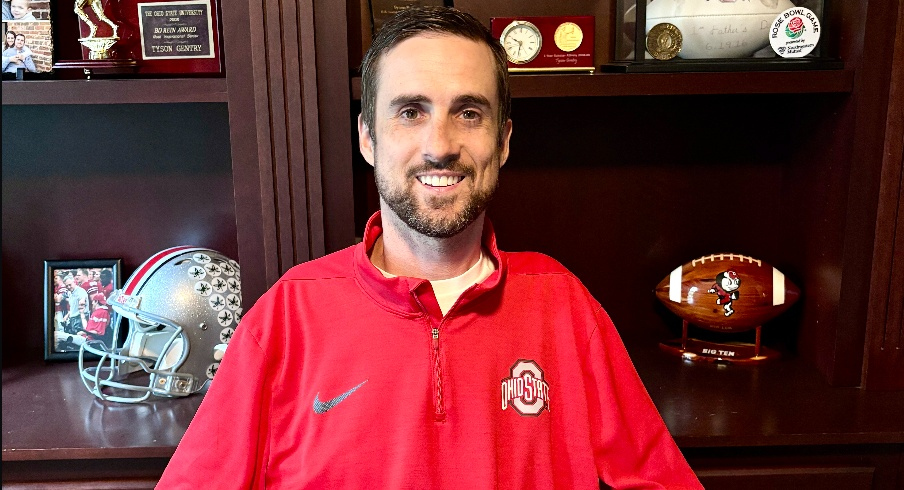
Twenty years after suffering a life-changing injury during an Ohio State football practice, Tyson Gentry is grateful.
Gentry has been paralyzed from the neck down since suffering a spinal cord injury during a spring scrimmage at Ohio Stadium on April 14, 2006. The former walk-on wide receiver eventually regained use of his biceps, but remains unable to walk or move his fingers or wrists.
Despite that, Gentry has a thriving life. He runs the New Perspective Foundation, which assists others who have suffered spinal cord injuries. He serves on the board and was previously the president of the National Football Foundation’s Columbus Chapter. He shares his life journey through public speaking, and has authored four books, including his new autobiography “Once A Buckeye…: A Story of Football, Family and Faith,” which was published this week.
Most importantly, Gentry is a husband to his wife Megan and a father to his two sons, 10-year-old Adam and 8-year-old Ryan. And it’s because of them that Gentry says he’d still choose to play football at Ohio State all over again even if he knew how his career would unfold.
“I really would. If I was able to answer that question while knowing that I would say I end up where I'm at with my wife and our two sons, Adam and Ryan, undoubtedly yeah, because I don't want to know what my life would look like without them,” Gentry told Eleven Warriors. “My wife is my angel. She makes things so much easier on me and helps me carry a lot of the burdens that come with my injury. So having her by my side is amazing. And then to watch our two sons, who are 10 and 8 now, grow up and to kind of show them so many things that they wouldn't otherwise be exposed to.”
In the immediate aftermath of his injury, Gentry questioned whether he’d ever have the opportunity to be a husband or a father. After undergoing fusion surgery three days after the injury, the pain was so intense that Gentry wished for death.
The following morning, however, Gentry’s parents showed him an inspirational note that told him to “Never give up, no matter how much adversity you face.” The note resonated with Gentry because he wrote it himself after a woman who suffered a spinal cord injury spoke to the Ohio State football team – eight months before his own injury – and asked them to write letters of encouragement to patients at Ohio State’s Dodd Hall, the same hospital where he’d soon undergo his own rehabilitation. Gentry took that as a sign from God, and it gave him the faith he needed to persevere.
“When I reached my lowest point and I was ready to give up, I honestly thought I was going to die. Just the amount of pain that I was in, I was ready to go, I was at peace with everything,” Gentry said. “And I woke up the next morning and realized that it's not the end of the road, and so just from that standpoint onward, my faith has increased.”
The coming months remained difficult for Gentry as he was told to “hurry up and wait” to see if he would regain more function in his arms and legs. But as he gradually came to accept that he would never be able to walk again or do many of the things that he loved to do before his injury, Gentry decided he didn’t want to spend the rest of his life dwelling on what he couldn’t do.
“I don't know that there was a specific point that I recall reaching that phase. But I do remember at some point coming to terms with the fact that like, OK, I obviously can't undo what happened, and I can't suddenly change my function and give myself hand movement or get up and walk or anything like that,” Gentry said. “So I think once I kind of realized like, ‘Hey, if this is what I have to work with moving forward, all I can do is make the best of it.’ Because the only alternative is to sit there and feel sorry for myself and spiral downward, and I didn't want that.”
Gentry says he wouldn’t be where he is now without the help of “countless people,” starting with his wife, children, parents and sisters. He remains close with Ohio State coach Jim Tressel and many of his former Buckeye teammates, including Kurt Coleman, the then-freshman defensive back who made the tackle – a tackle that Gentry described as routine and that he does not blame Coleman for – that changed Gentry’s life forever. Gentry, who gave his sons the middle names Cole in honor of Coleman and James in honor of Tressel, is also grateful for the support he’s received from Buckeye fans throughout the past two decades.
“The Ohio State community in general, like writing me letters when I was in the hospital, so many fans from around the nation and even around the world were there to help pick me up and give me encouragement. And then on down the line over these years, just to be in that brotherhood and be a part of that community means the world to me,” Gentry said. “Because I idolized it in so many ways as a kid and looked up to these warrior-like athletes that, sure, I know my career as an Ohio State Buckeye is not the famed career that a lot of guys have had, in a number of ways, but it's also a very unique experience that I had in the ending of my career that I've had to be able to say that like, look, I'm making an impact in a different way and I'm very grateful for that. So the Buckeye Nation community in general, along with my teammates, have carried me through a lot for sure.”
“I really would. If I was able to answer that question while knowing that I would say I end up where I'm at with my wife and our two sons, Adam and Ryan, undoubtedly yeah, because I don't want to know what my life would look like without them.” – Tyson Gentry on whether he would choose to play football at Ohio State again even if he knew he would be paralyzed
Gentry still thinks about how different his life could be if he hadn’t suffered the injury. Specifically, Gentry wishes he could play sports with his kids and do all of the things he would do as a father if he weren’t confined to a wheelchair. But he’s grateful to be able to show his sons the power of faith and perseverance.
“I wish I could teach them how to throw a ball and wrestle with them and do all these things that I looked forward to before my injury,” Gentry said. “As difficult as that is to realize that I can't do, I'm grateful to be able to show them what mental toughness looks like and what trust and faith in God looks like and what it looks like to be a man of character and integrity. So there's always a silver lining to things that go bad.”
Gentry hopes his new book provides the same inspiration to others.
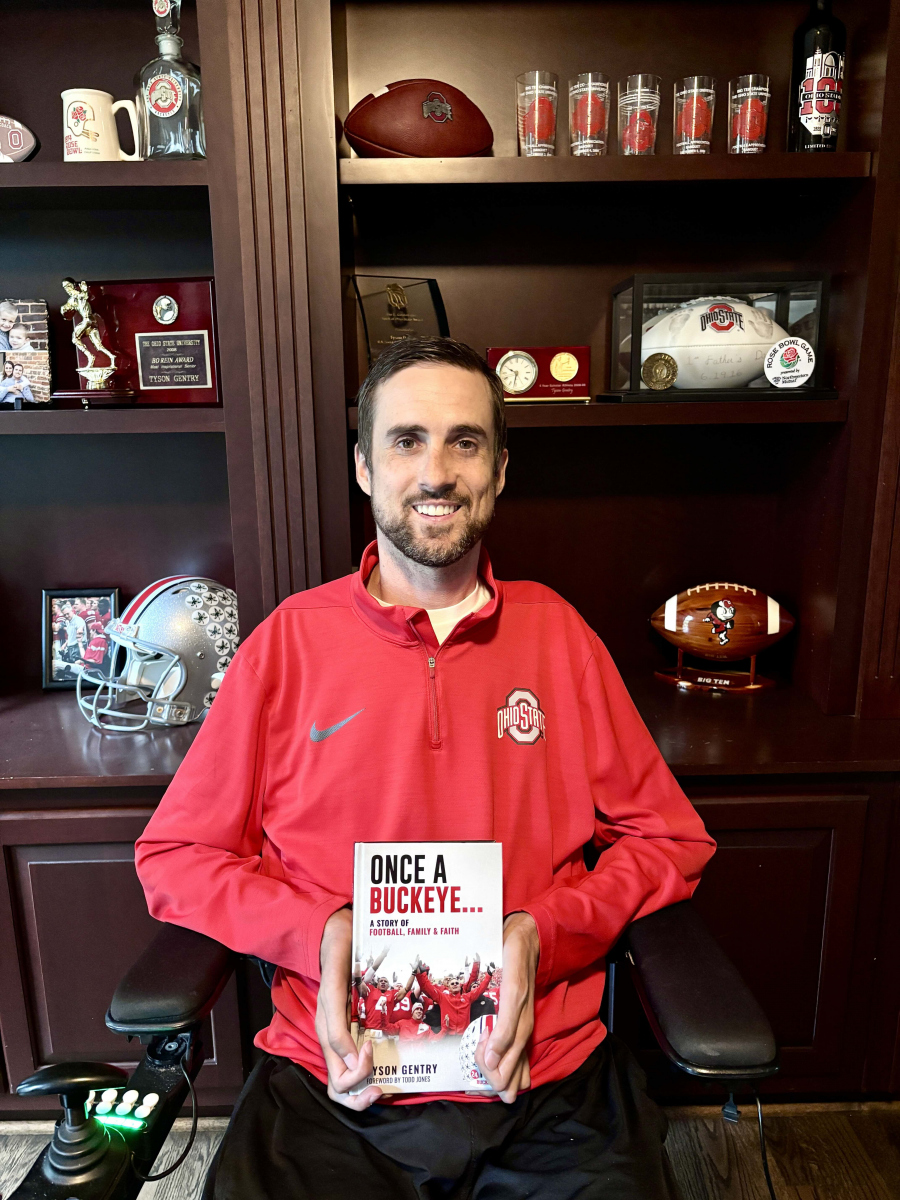
Tyson Gentry with his book, “Once A Buckeye…: A Story of Football, Family and Faith.”
“Really at the end of the day, when bad things happen, adversity is basically just opportunity in disguise,” Gentry said. “You'll never find out what you're made of until you go through something tough. And so it's just those opportunities that as not fun as they are and they seem at first, they still are opportunities to better yourself, to be stronger, and to help others and encourage others.
“Basically, through it all, the gist of my story is that a lot of good can come from bad situations,” Gentry added. “As much as I thought my life was over at the time because everything that I knew and identified with was gone in a second, a lot of good has come from it.”
“Once A Buckeye…” is more than a decade in the making. Gentry began writing his memoir in 2014 and completed about 75% of it, but wasn’t sure how to end the story at the time. As he came up on the 20th anniversary of his injury this year, however, Gentry decided it was time to finish the book and share his story with the world in his own words.
“At the time, I wasn't a dad. At that point, I was married for about a year. So I realized that I still had plenty of life to live, and it's kind of hard to write an autobiography/memoir without knowing how it's going to end,” Gentry said. “So I shelved it and really didn't think about it for a while. Wrote a few other books. And then just recently after I finished my previous book, it just seemed like the right time.”
Writing the book was powerful for Gentry, he said, as he reflected on life both before and after his injury and the journey that’s brought him to where he is now. He wrote openly and honestly about the hard times he faced after his injury, wanting to show others that it’s OK to struggle when things don’t go as planned, but also told stories about his Ohio State football career and reflected on the moments in his life from before his injury that came full circle after his injury.
“I tried to be as honest and at times raw as possible,” Gentry said of writing the book. “My internal struggles as a walk-on to kind of compete and hold my own against guys who are on scholarship and just kind of give readers an insight of what that was like for me, and then just the honesty of what I went through after my injury to let people know that even if you're a tough, strong athlete, that even we struggle and break down and have times of weakness too. So it's only human to struggle when you experience a life-changing event and that at the end of the day, God is always good and that good can come from it.”
You can read Gentry’s full story in his own words by purchasing “Once A Buckeye… A Story of Football, Family and Faith” on Amazon.
