It’s often said that football games are won and lost in the trenches. That proved all too true for Ohio State in its final two games of the 2025 season, particularly on the offensive side of the ball.
Across 12 regular-season games, Ohio State was one of the best pass-protecting teams in college football. The Buckeyes allowed just six sacks in the regular season, allowing Julian Sayin to emerge as college football’s most efficient passer as Ohio State went 12-0. Ohio State’s rushing offense was far more inconsistent, but the offensive line appeared to be peaking at the right time when it controlled the line of scrimmage to lead the Buckeyes to a 186-yard rushing day and a 27-9 win in the regular-season finale at Michigan.
That, however, proved to be the peak of the season for an offensive line whose performance fell off a cliff from there.
After the Buckeyes gave up five sacks and ran for just 58 yards on 26 carries in their 13-10 loss to Indiana in the Big Ten Championship Game, there was still optimism that Ohio State’s offensive line would bounce back and find another gear in the College Football Playoff. After all, that’s exactly what Ohio State’s offensive line did a year ago, when it bounced back from a poor showing in a 13-10 loss to Michigan for a quartet of excellent performances in the CFP to lead Ohio State to a national championship.
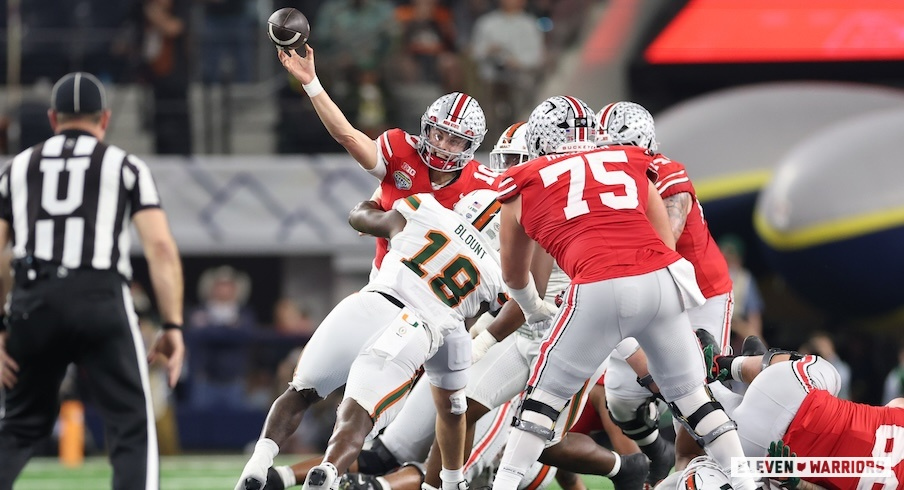
Instead, Ohio State’s offensive line proved overmatched in the Buckeyes’ first and only CFP game this season, allowing another five sacks as Ohio State ran for just 45 net yards on 24 attempts in its season-ending 24-14 loss to Miami in the playoff quarterfinal at the Cotton Bowl.
Ohio State’s offensive line had been one of its biggest areas of concern all season, but it played few opponents during the regular season who were good enough to truly expose its flaws. Those flaws were laid bare by Indiana, giving the Buckeyes 25 days between games to work on correcting those issues. But those efforts proved futile against an elite defensive front from Miami, which leads the nation with 46 sacks this season.
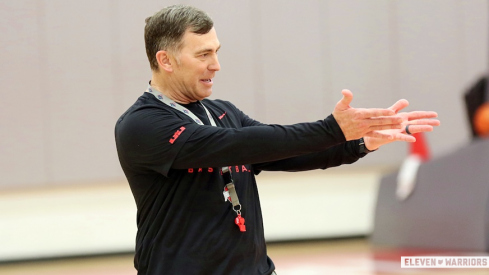
“Not at all did we underestimate the matchup. We knew we were playing against a good front. We prepared, planned for that front. We just did not execute well early,” Ohio State offensive line coach Tyler Bowen said after the game.
It didn’t help that Ohio State was plagued by multiple injuries to starting offensive linemen vs. Miami. Right guard Tegra Tshabola was ruled out before the game due to injury, and Gabe VanSickle struggled in his first start, ultimately prompting a switch to Joshua Padilla in the second quarter. Left tackle Austin Siereveld played through a leg contusion in the first half but was clearly hampered by the injury, so Ian Moore replaced him for the second half.
But season-ending injuries to two of the top three players on last year’s offensive line, Josh Simmons and Seth McLaughlin, didn’t stop the Buckeyes from winning a national championship a year ago. And Bowen didn’t use the injuries as an excuse for how his unit played against the Hurricanes.
“We have a next man up mentality, and I think a couple guys stepped in and did some good things. Certainly, we want to have Austin out there, and Austin's a warrior, battled through it as long as he could, and I'm proud of Austin for that,” Bowen said when asked about the impact of Siereveld’s absence. “But just overall, as a group, we didn’t play well enough to win the game.”
Ohio State could potentially return its entire starting offensive line next season, setting up the Buckeyes to have one of college football’s most experienced offensive lines in 2026. All of Ohio State’s top eight offensive linemen from this season have at least one more year of eligibility.
Siereveld, left guard Luke Montgomery and center Carson Hinzman are the most realistic candidates among them to consider entering the 2026 NFL draft, but Hinzman indicated after the Cotton Bowl that he was leaning toward staying for his fifth-year senior season.
“I don't have any pressure to leave,” Hinzman said. “If the opportunity presents itself, I'm coming back. If there's a better opportunity at the next level, then maybe that would be another choice, but that would be a decision I would make with God and my family. But I love it here. I have no problem staying here and being Unc for another year.”
Montgomery and Siereveld both said they had to decide whether they would stay at Ohio State for a fourth year, but Montgomery believes the experience he and his teammates gained this season and in past seasons will be valuable for the offensive line in 2026.
“We've already been in it, we've learned from it,” Montgomery said after the Cotton Bowl. “If I come back for my last year, it will be my fourth year. It’ll be my last year, and through three years, I've learned a lot.”
Hinzman offered a similar assessment for why he’s optimistic about what Ohio State’s offensive line can be in 2026.
“For us to grow in maturity and grow in knowledge of the game, because we have a lot of maybe not necessarily young guys but younger guys on the team that will be more mature next year, we have a lot of opportunity in that aspect,” Hinzman said.
That said, the disappointing end to the season raises questions about whether the Buckeyes should run it back with this year’s group of offensive linemen or if they should seek out upgrades in the transfer portal.
The biggest spot where Ohio State could look for an upgrade is at right guard, where Tshabola split snaps with the likes of Padilla, VanSickle and Ethan Onianwa (who’s out of eligibility) throughout the 2025 season despite starting every game in 2024. While the Buckeyes have three legitimate options to start at that position next year in Padilla, Tshabola and VanSickle, they’ll have to decide whether they’re confident one of them can lock down the job and be a consistently reliable starter.
Right tackle is another position where Ohio State could have reason to bring in competition after a rough end to the season in pass protection for Phillip Daniels. The Minnesota transfer, who started every game except the Purdue game (which he missed due to injury) at right tackle for Ohio State this season, allowed a team-high 19 quarterback pressures, including six in the final two games, per Pro Football Focus.
Perhaps the biggest difference in the postseason for Ohio State’s 2025 offensive line vs. its 2024 offensive line was that it didn’t have a player like Donovan Jackson, who transitioned from left guard to left tackle following Simmons’ injury and ended up becoming a dominant player at his new position in the CFP, leading to a first-round draft selection. The Buckeyes didn’t have any first-team All-Big Ten offensive linemen this year (though Hinzman was named a first-team All-American and Montgomery was named a second-team All-American by the AFCA), so they’d be smart to monitor the transfer market for anyone who has the potential to be that kind of difference-maker in 2026.
The other big difference was coaching, as Bowen replaced Justin Frye last offseason after Frye left Ohio State to become the Arizona Cardinals’ offensive line coach. Bowen had limited experience as an offensive line coach before joining the Buckeyes, only coaching that position full-time for three previous seasons at Fordham (2015-16) and Maryland (2017), and the Buckeyes’ poor play up front in the postseason raised questions about whether he’s the right man for the job.
It’s unlikely Ohio State will change offensive line coaches after just one season with Bowen coaching the unit, but Bowen acknowledged after the Cotton Bowl that he has to take a hard look at what went wrong at the end of the season to get his unit to play up to the standard that’s expected at Ohio State.
“We have to continue getting it there. We're obviously not there based on that performance,” Bowen said. “And we've got to look at everything, starts with me, looking at everything and how we can get the offensive line to be able to perform at the level that we need to in a game like that.
“I don't think you've ever found me after a game and think that the offensive line is up to the standard. After any game we play, win or lose, the issues are always there. We try to constantly address those issues. I've gotta take a hard look at what we're doing and make sure the issues get addressed.”