Before each Ohio State game, Eleven Warriors catches up with a media member who covers the opposing team to get his or her perspective on the Buckeyes' upcoming opponent.
#2 Indiana
Hoosiers

For Big Ten Championship Game week, we welcome Taylor Lehman, who you may remember from his past tenure as a recruiting reporter for Eleven Warriors. Lehman now covers Indiana for Bite-Sized Bison, a website specializing in data-driven analysis on Indiana football.
You’ll see plenty of that data-driven analysis in this week’s Across The Field, as Lehman explains how Curt Cignetti turned Indiana into a championship contender so quickly and breaks down the threats the Hoosiers will present to Ohio State in this weekend’s battle between college football’s only two remaining unbeaten teams. Complete with graphics, Lehman explains what’s made Fernando Mendoza so successful as Indiana’s quarterback this season, the Hoosiers’ other players to watch and why no one’s been able to beat Indiana this season.
If I told you two years ago that Indiana would be 12-0 right now on its way to its second straight College Football Playoff, would you have believed me?
Lehman: *laughs* No.
Save for a couple seasons, I’ve covered this program since 2014, through the Kevin Wilson days – when the 2015 New Era Pinstripe Bowl loss (a 6-6 regular season) signaled potential for the future – and through the Tom Allen days – when Kalen DeBoer, Kane Wommack, and Mike Penix were the main characters all along – so I’ve seen plucky Indiana teams that weren’t exactly standing on solid foundation. But what we’re seeing now is Curt Cignetti building upon the transplanted James Madison foundation until it’s become Indiana’s own, and it’s more real than anything an Ohio State fan may have seen from this program since the late 1980s.
I try to maintain an objective position as an analyst covering Indiana, so coming into this year, I trusted the data when it suggested Indiana was a toss-up between 8 and 9 wins, with only a 0.1% chance of 12 wins. And before 2024, I predicted 7 wins. I never would’ve allowed myself to believe Cignetti would have Indiana at 23-1 through his first two slates, even though I was optimistic about the hire in December 2023. This is fairy tale stuff, and I often need to zoom out to appreciate it on a weekly basis.
From your vantage point, how has Curt Cignetti taken Indiana to heights it’s never reached before so quickly?
Lehman: I could write a novel on this question, and I hope someone does one day, because pundits believe a program can simply “follow the Cignetti blueprint” while only seeing the tip of the iceberg.
It’s a peculiar aligning of stars at several levels: 1.) Curt Cignetti finally breaking through as a head coaching candidate at the FBS level, 2.) Indiana University, under a fairly fresh administration as a university and athletic department, deciding to finally pour its pre-existing resources into its football program, and 3.) college football trudging through this new NIL and transfer portal era, allowing programs to quickly flip rosters if they invest enough. All of those concepts sort of eclipsing at the exact moment in December 2023 set the scene for this explosion in Bloomington.
Cignetti approaches the head coaching role in a very modern way, with a focus on developing coaches within his own vision for the program, and he’s been developing his two coordinators (Mike Shanahan and Bryant Haines) for the larger part of a decade, as he’s moved from job to job at lower levels. He’s had the same strength and conditioning coordinator (Derek Owings) since 2021 and the same special teams coordinator/TEs coach (Grant Cain) since 2019. Haines was promoted to DC at JMU after the departure of Corey Hetherman, who is now the DC at Miami, and Cignetti’s already replaced his longtime QBs coach Tino Sunseri (who’s since been fired as OC at UCLA) with former OSU GA Chandler Whitmer, who’s coached Fernando Mendoza in his first season as a true QBs coach. Cignetti has an eye for coaching talent, and his first tall operational task at Indiana may be replacing the two coordinators who’ve been two of the best in the country.
For Indiana as a university, AD Scott Dolson said Cignetti told him during the interview that even with average resources, he could win. Now, the university is offering more than that. This is most notable in its on-field assistant salary pool, which has grown from $4.9M in 2023 to $7.6M in 2025 (would’ve ranked 13th nationally in 2024). That figure has grown since most recent reporting, too, as Indiana fought off Penn State for its DC and other power conference programs for its OC. It also fought off USC for its S&C coordinator. This particular investment has been a point of emphasis for Cignetti during contract negotiations too.
Then, NIL has created the environment for Cignetti to quickly turn over a program like Indiana in ways that didn’t exist when his fateful path to Bloomington began. He brought many key playmakers from JMU – Elijah Sarratt, Aiden Fisher, D’Angelo Ponds, Tyrique Tucker, Mikail Kamara, and a few others who’ve already graduated – but he also made massive pulls that floored Indiana fans immediately, such as outpaying LSU for former DT CJ West, swinging former RT Trey Wedig from Wisconsin, pulling the biggest existing star in former Maryland RB Roman Hemby, and of course, winning over Fernando Mendoza in the face of Miami (a few miles from his home). They also retained LT Carter Smith during the transition, which seemed impossible.
In recognizing this sudden success, there’s also room for asking why it didn’t happen earlier, which is a legitimate question, as the university didn’t believe it could sustain football success historically. But now, it seems they’re all-in, as they extended Cignetti midseason in just 48 hours, introduced a mascot inspired by its football program’s history, provided funds to hire industry-standard support staff, and funded compounding recruiting talent developing behind the temporary portal-built frontline we’re seeing on the field now.
This type of hire, and this type of change, isn’t simply a matter of finding the coach; it’s a collective change, and that’s what’s happening in Bloomington now. As someone who covered Ohio State recruiting (for this very site!), as well as many years of Indiana recruiting, Indiana’s operations run far closer to the standard and efficiency of an Ohio State than that of the Tom Allen- and Kevin Wilson-led Indiana programs. The Hoosiers will be competitive for quite some time.
Fernando Mendoza enters the Big Ten Championship Game as a slight favorite over Julian Sayin to win the Heisman Trophy. What’s made him such a great quarterback for Indiana this season?
Lehman: I’m finishing my 12th season covering college football, and I’ve never heard a QB talk about the intricacies of defensive schemes the way Fernando Mendoza does. You may have listened to The Triple Option podcast episode where Urban Meyer was floored by the way Mendoza discussed Penn State’s defense. While talk about intangibles has become cliché, Mendoza has reinvigorated that idea for me personally, as he clearly is supreme at preparation and pre- and post-snap reads. Of course, he also makes all the throws and operates a fairly RPO-heavy scheme too.
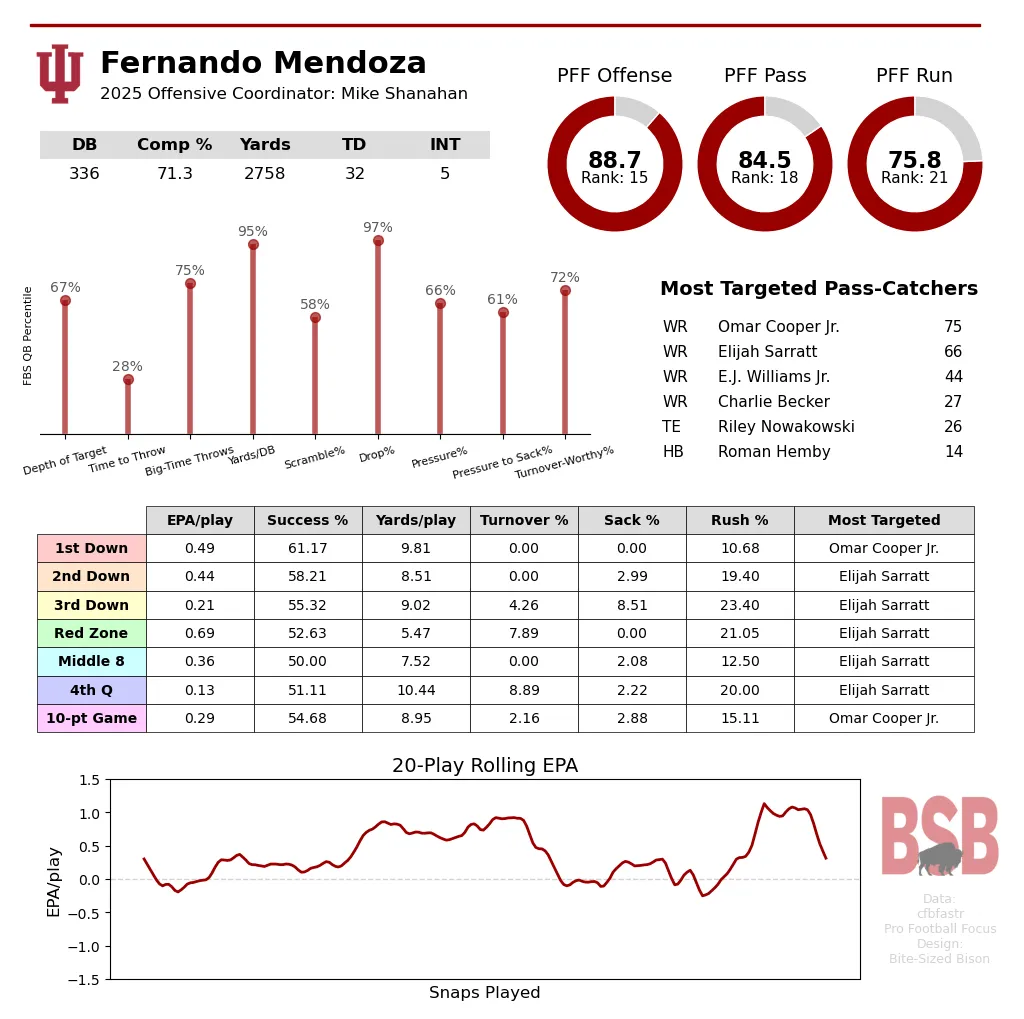
What likely hurts Mendoza’s Heisman case the most is that he passes or runs on just 49.7% of Indiana’s non-garbage snaps, which is 15th in the conference, just behind Julian Sayin. A more dynamic QB – in both cases – might have a stronger command on the race. But what Mendoza has that Sayin will be searching for this weekend are those Heisman moments the voters are always looking for. The game-winning touchdowns against Oregon, Iowa, and Penn State all came from his arm, including his leading an 80-yard touchdown drive in 1:15 to take the lead at Penn State.
In this particular matchup, Mendoza has the second-most career dropbacks among the Power 4 QBs Ohio State has played in 2025.
Who are some of the other Indiana players most capable of giving Ohio State problems?
Lehman: Outside of Fernando Mendoza, the offensive player who might be the toughest matchup for Ohio State’s defense is Omar Cooper, simply because of his versatility and athleticism. He makes catches in all areas of the field and is fifth among Big Ten pass-catchers in YAC/reception, making him a good tool to unravel structurally sound defenses, like Oregon’s, when Cooper recorded a season-low 3.4 average depth of target, 37 of his 58 yards were via YAC, and five of his seven catches were conversions.
For the real sickos, Riley Nowakowski (a Wisconsin TE transfer) brings value on every play. He’s graded by PFF as the third-best blocking TE in the Big Ten and is also second in yards after catch. He makes the running attack tick in ways similar to Zach Horton last season, and he broke into the passing scheme while Elijah Sarratt was sidelined for a few weeks recently. He will most likely have one or two plays with the ball in space.
On defense, Indiana has nine All-Big Ten honorees – including four first-team honorees – and everyone knows Aiden Fisher and D’Angelo Ponds. But the defender that makes it all go is nose tackle Tyrique Tucker. Indiana attacks offensive fronts like an arrow, applying significant pressure with its interior DL, and as a result, Tucker is 4th among FBS NTs (200+ snaps in the A-gap) in QB pressures, and he and his teammate, DT Mario Landino, are tied for 5th among all DTs in sacks.
What should scare Ohio State fans most about Indiana entering this game?
Lehman: On a macro level, Indiana has won in many ways this season, which is different than last season. They’ve won at Oregon, at Penn State, and at Iowa, and each win offered its own set of challenges that tend to trip up teams that aren’t real. Iowa ambushed Indiana with blitzes at a volume it hadn’t seen to that point; Penn State brought a ton of rushing power and averaged 3.5 yards/carry; and Indiana unleashed its linebackers against Oregon’s offense in a way it hadn’t before. There is no singular way to beat this Indiana team like there has been in years past.
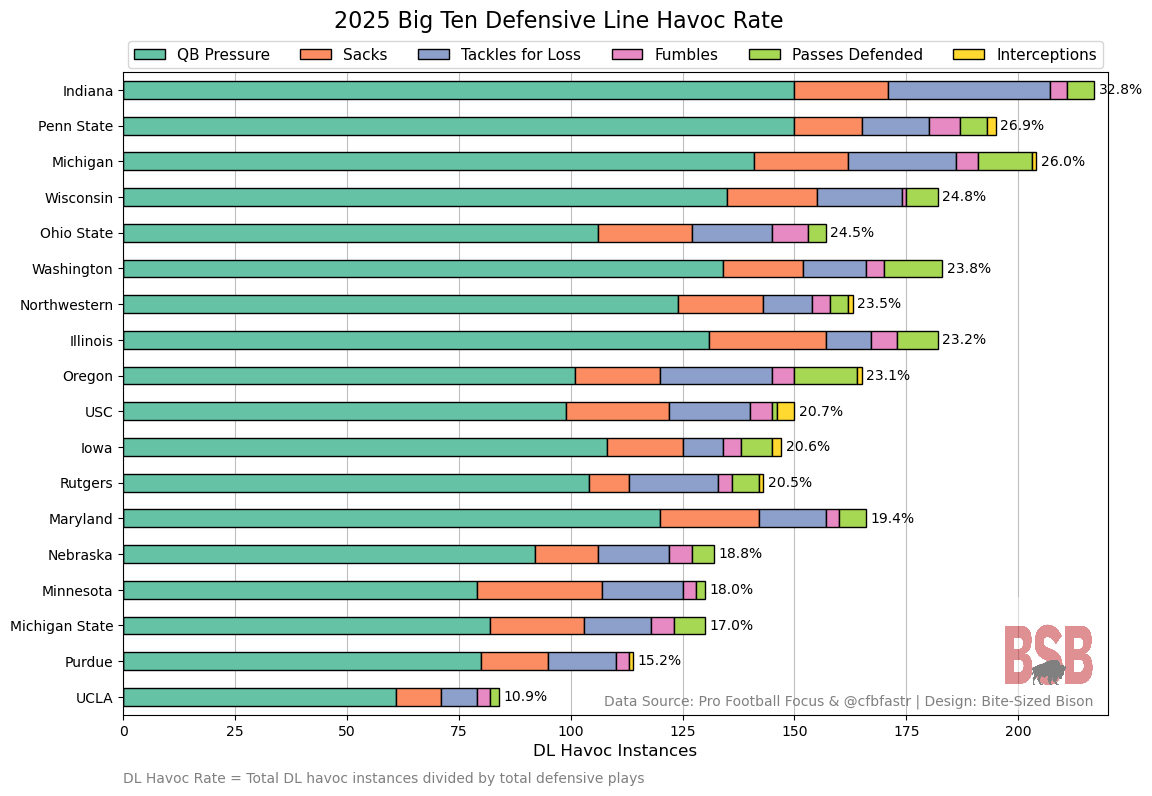
On a micro level, Indiana’s strength is in its defensive front. Ohio State has not seen a front seven like Indiana’s yet this season, and that’s not a knock on the Buckeyes’ schedule. Very few fronts are as dynamic as Indiana’s which is why it leads the country in front-seven havoc rate. It’s not necessarily because of the individual talent; it’s more in the versatility and scheme, and Bryant Haines is among the best at scheming a defensive front right now. It’s a front that can take on numerous looks from play to play – five linemen or three linebackers or a nickelback – and leverages its strengths while hiding its weaknesses. For example, at one point midway through the season, third linebacker Isaiah Jones led the conference in TFLs (now 6th) despite seeing the field pretty sparingly, and after starting edge Kellan Wyatt went down for the season, Kent State transfer DE Stephen Daley took over full-time in Week 5 and has amassed a nation-leading 18 TFLs. It’s a constantly developing scheme that is central to the defensive success Indiana has found so far.
What’s Indiana’s biggest weakness that Ohio State could potentially exploit?
Lehman: There are two that are somewhat concerning from the Indiana perspective: 1.) the health of the offensive line, and 2.) the secondary’s ability to defend the Ohio State passing game if the front can’t get pressure on Sayin.
Much like 2024, Indiana lost Drew Evans at LG entering the latter part of the season. He hasn’t played since Week 9, and it’s shown at times. RT Kahlil Benson has also been toughing through an injury and missed most of Indiana’s finale against Purdue. The two teams who’ve run decently against Ohio State (Purdue and Michigan) did so with more gap schemes than zone, but Indiana is pretty heavy in zone. Ohio State’s nose tackle Kayden McDonald will be a key factor in this one.
Bryant Haines’ scheme is DB-friendly because, as has been noted already, its priority is attacking from the front in extreme fashion. Most of Indiana’s pass defense success is thanks to the front influencing what an opposing QB does and feels. If Sayin is comfortable, this secondary will struggle. It seems almost inevitable that Carnell Tate will have a big play downfield.
How do you see the Big Ten Championship Game playing out?
Lehman: As I’ve watched this season play out, I’ve thought to myself, “Ohio State, Indiana, and (insert third team like Texas Tech or Texas A&M) are the clear leaders on the national level,” and now, it’s really just these two teams. These are really the only two teams who could show the measure of the other, and what’s rare about this type of matchup is that there’s seemingly no trap door beneath the loser.
The analytics all suggest this is damn near 50-50, and I think it’ll be very close. I haven’t seen a reason to pick against Indiana yet. The Hoosiers have been tested in ways I think could be beneficial this weekend, and I think that could be the difference. Fernando Mendoza has thrown three game-winning touchdowns this season (against Iowa, Oregon, and Penn State), and it wouldn’t be shocking to see him do it again.