Welcome to the Skull Session.
It's Survive and Advance for Ohio State baseball.
FINAL | SURVIVE AND ADVANCE (+ a 98-pitch complete game from @pierce_1002)
— Ohio State Baseball (@OhioStateBASE) May 20, 2026
Buckeyes will play tomorrow at 7 p.m. ET against the loser of No. 7 Michigan/No. 11 Washington. #GoBucks pic.twitter.com/ywfaVE91v5
Have a good Thursday.
SAY THAT AGAIN…? Big Ten commissioner Tony Petitti and the conference’s 18 schools are all in on a 24-team College Football Playoff. Why? Because it benefits the league — and its television partners. More on that in a moment, but for now, here’s a quote from Petitti on how an expanded postseason makes the regular season more valuable:
“All of a sudden, your November content —”
Content?
That’s all you need to read to understand Petitti’s motivation for expanding the CFP. More teams means more games, which means more opportunities for FOX, CBS, and NBC to televise meaningful matchups in November and December.
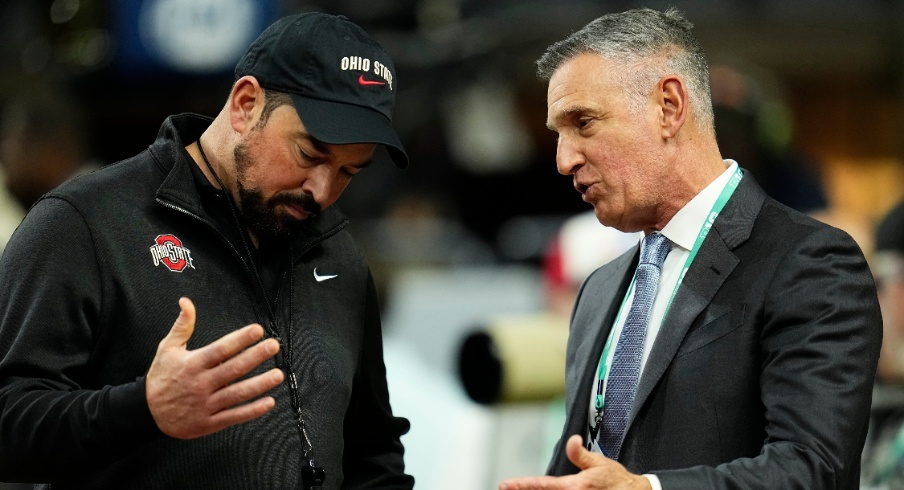
That’s the real driving force here, even if Petitti frames it differently as this (continuing the quote from above): “Your competitiveness is way up, your stadiums are looking great, and everybody’s jumping around. Like, that’s a big piece of it… You’ve got real value there, so I think there’s more than one way to think about this from a value proposition — not just every dollar that we capture from the CFP, but also what does it mean for the short term of the regular season, and what’s the long-term value?”
Content.
Value.
Every dollar.
Expanding the CFP is just good business.
THE BATTLE INSIDE. The Athletic’s Stewart Mandel made an excellent point this week: the push to expand the College Football Playoff isn’t really about the Big Ten vs. the SEC — it’s about FOX vs. ESPN.
Because while commissioners talk about “access,” “value,” and “strengthening the regular season,” the real power centers are the television partners who ultimately decide what that value actually is.

FOX is pushing the Big Ten toward a 24-team field for one simple reason: inventory. More playoff games means more inventory, more partners involved in the product, and more opportunities to turn December into a multi-network showcase. ESPN, which currently holds the CFP’s primary rights through 2032, sees it differently. Scarcity is the product. Fewer teams means higher stakes, bigger exclusivity, and more control over the sport’s most important window.
And just like Petitti framed expansion in terms of “content” and “value proposition,” the networks are doing the same thing — just with different incentives attached. FOX believes more access creates more value. ESPN believes too much access dilutes it.
That’s the real divide here.
Not conferences.
Not even competitive balance.
It’s who gets to define what “value” in college football actually means.
THIS FERTILE GROUND. Last weekend, Ohio State landed a commitment from four-star defensive end Wyatt Smith, the No. 11 defensive end and No. 78 overall prospect in the 2027 class.
Smith hails from Florida, a land known for its oranges — and its elite high school football talent. Ohio State has long recruited the Sunshine State, with Joey Bosa and Nick Bosa among the most notable Buckeyes to come out of Florida pipelines. (Fun note: the Bosa brothers came from the same high school as Smith).
In recent years, however, the Buckeyes have made Florida a clear priority on the recruiting trail, landing high-end prospects such as Kenyatta Jackson Jr. (Miami Gardens), Brandon Inniss (Hollywood), Jeremiah Smith (Miami Gardens), TJ Alford (Port St. Lucie) and Simeon Caldwell (Jacksonville). They’ve also added Florida talent through the transfer portal, including Earl Little Jr. (Plantation) and Ja’Kobi Jackson (Pensacola).
#BOOM Four-star defensive end Wyatt Smith, the No. 11 edge and No. 78 overall prospect in the 2027 class, commits to Ohio State.https://t.co/cYe16cvYys pic.twitter.com/zani0QADdc
— Eleven Warriors (@11W) May 17, 2026
According to a recent analysis from The Athletic’s Manny Navarro, the move makes even more sense for Ryan Day and his staff. Since 2015, 13 Florida regions have produced 334 NFL Draft picks, including 47 first-round selections:
- Broward County (69)
- Miami-Dade (50)
- Tampa/St. Petersburg (50)
- Orlando/Central Florida (49)
- Jacksonville (31)
- Panhandle (23)
- Palm Beach County (21)
- Naples/Southwest Florida (14)
- Gainesville/Ocala (13)
- Treasure Coast (4)
- Bradenton (4)
- Big Bend (3)
- Melbourne/Space Coast (3)
That production will include a growing pipeline of future Buckeyes in 2026. Jeremiah Smith is a guaranteed first-round pick down the line, while Jackson, Inniss and Little could all elevate their draft stock with strong seasons this fall.
Regardless, Ohio State would be wise to continue returning to this fertile ground. It consistently produces elite football talent.
“I AIN’T COME HERE TO PLAY SCHOOL!” Cardale Jones has one of the best tweets of all-time.
On Oct. 5, 2012, Jones — then a backup Ohio State quarterback, two years before his national championship run with the Buckeyes — posted this: “Why should we have to go to class if we can here to play FOOTBALL, we ain’t come to play SCHOOL, classes are POINTLESS”.
This week, Jones and his Ohio State head coach, Urban Meyer, discussed the tweet during Meyer’s appearance on The Script. Meyer shared his reaction to seeing the post 14 years ago, and what he thinks of it now:
.@CoachUrbanMeyer didnt mind @CJ1twos legendary tweet @3xOptionShow @BeanieWells26 @DaveHolmesTV pic.twitter.com/Vt2j4MXvMj
— THE SCRIPT (@TheScriptOSU) May 20, 2026
“I guess I’ve never overreacted. Was I upset? No. I mean, it’s stupid stuff, and we’ve all done stupid stuff,” Meyer said with a smirk.
Stupid?
Yes.
Iconic?
Also yes.
SONG OF THE DAY. "Twenty-Four" - Switchfoot.
CUT TO THE CHASE. Bret Bielema talks AFCA recommendations, CFP expansion: "As many teams included as humanly possible"... The origin story of Caitlin Clark's competitiveness totally tracks... Nutrition science’s most preposterous result: Studies show a mysterious health benefit to ice cream. Scientists don’t want to talk about it... Very difficult and extremely cool: how to start doing pull-ups... Missouri's Ahmad Hardy starts road to rehab, thanks supporters