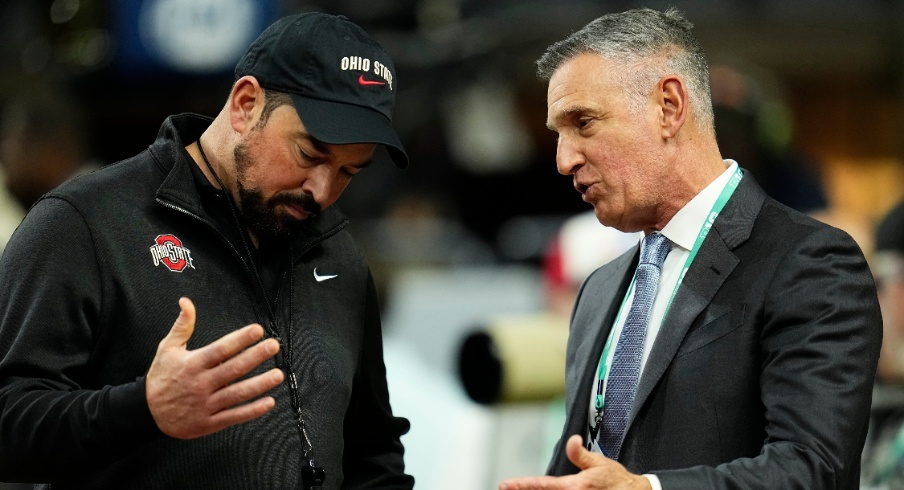
The Big Ten has made its stance clear: Bigger is better when it comes to the College Football Playoff.
During an hour-long meeting with reporters at the Big Ten meetings in Rancho Palos Verdes, California, commissioner Tony Petitti said all 18 conference schools unanimously support expanding the CFP to 24 teams — a format that would dramatically reshape the postseason and further cement the Big Ten’s influence over the future of college football.
“That’s having been incredibly successful in the 12-team format,” Petitti said, per The Athletic’s Scott Dochterman. “The willingness to make a change and consider giving up our championship game to get to the right postseason, I think our coaches and our administrators understand that tradeoff.”
The ACC and Big 12 also support a larger CFP; however, the SEC has yet to take an official stance, creating a roadblock to the Big Ten’s plans. The two conferences will need to agree on a new structure, or the CFP will remain at its current 12-team format.
“We feel strongly about it, and we’re working really hard with our colleagues and the other conferences,” Petitti said. “Obviously, the way this is structured, we understand that the SEC and the Big Ten have to come to an agreement, and we’re working hard to figure out ways to get to a solution. But inside our league, there is a deep commitment to 24 and the access.”
“We feel strongly about it, and we’re working really hard with our colleagues and the other conferences... inside our league, there is a deep commitment to 24 and the access.”– Tony Petitti on the CFP expanding to 24 teams
While Ryan Day has questions about whether a 24-team format benefits Ohio State, other Big Ten coaches have little doubt.
“I don’t think we like the 24-team playoff; we absolutely love the 24-team playoff, especially at the University of Minnesota,” Gophers coach P.J. Fleck told Dochterman this week. “It allows us to have a way better chance to be able to play in the College Football Playoff every single year, based on the resources that we have and the challenges we have.”
Michigan State coach Pat Fitzgerald agreed, pointing to 2025 Iowa as an example of a team that would have been a threat in an expanded format.
“Go to that Indiana game or that Oregon game in Kinnick (Stadium). Those are Playoff-level games,” Fitzgerald said. “Those were as a good of football games as I’ve ever seen, two really good teams going at it. If Iowa would have got in there, nobody would want to play them.”
Petitti diminished any concern that an expanded format could make the regular season less important. In fact, he argued the opposite would be true.
“All of a sudden, your November content, your competitiveness is way up, your stadiums are looking great, and everybody’s jumping around. Like, that’s a big piece of it,” Petitti said. “You’ve got real value there, so I think there’s more than one way to think about this from a value proposition — not just every dollar that we capture in the CFP, but also, what does it mean for the short term of the regular season, and what’s the long-term value?”
He added, “I’m just in a very different place, but those who feel like it hurts the regular season, I have a hard time understanding.”