Time and change will surely show, alright.
The way we view college football and its importance has certainly changed over the last 60-plus years.
The Rose Bowl is known as "The Granddaddy of Them All," a bowl game that many wish and dream they could play in. But in 1961, the Buckeyes declined an invitation to the game.
Following a dominant 50-20 win over Michigan, Ohio State finished the regular season 8-0-1, outscoring opponents 221-81 along the way while led by Heisman Trophy runner-up Bob Ferguson, Paul Warfield and Matt Snell, among others. Following their dominant regular season, the Buckeyes were invited to the Rose Bowl.
But that's where things became interesting, and the problems began.
There was a multi-year contract dispute between the Big Ten and the Rose Bowl. At the time, regional games garnered more attention than national championships. Another obstacle was a recruiting scandal involving Woody Hayes in 1955, after Hayes admitted in an interview with Sports Illustrated that he had given extra money to players in need, which was considered an NCAA infraction at the time.
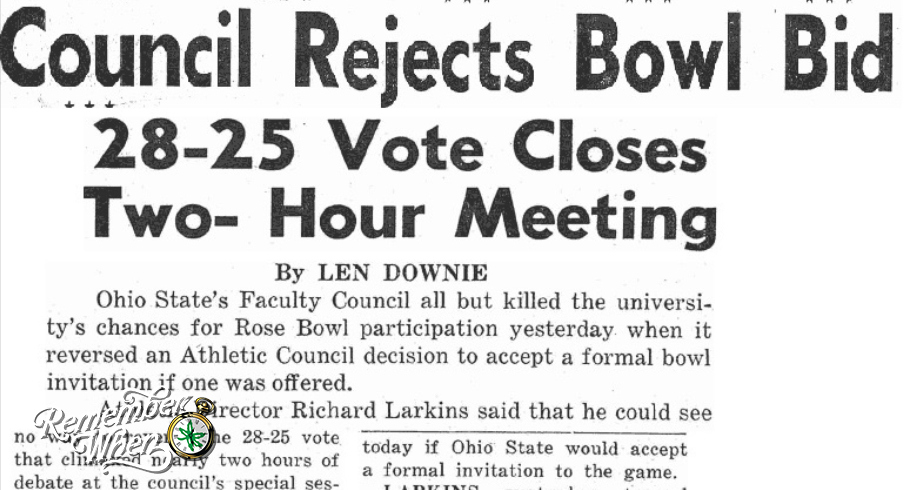
The Ohio State faculty voted 28-25 against the Buckeyes participating. That vote came after a secret meeting of the athletic council, where the group of 10 people voted 6-4 in favor of the Buckeyes heading to Pasadena, California.
In the end, the faculty chose to have the focus remain on academics, as longtime secretary of the Ohio State University Alumni Association Jack Fullen had been questioning the overemphasis of football on OSU's campus.
The Rose Bowl bid ultimately went to Minnesota, and the Golden Gophers played UCLA in the game on New Year's Day.
The November 29, 1961, issue of The Lantern explained the situation 65 years ago:
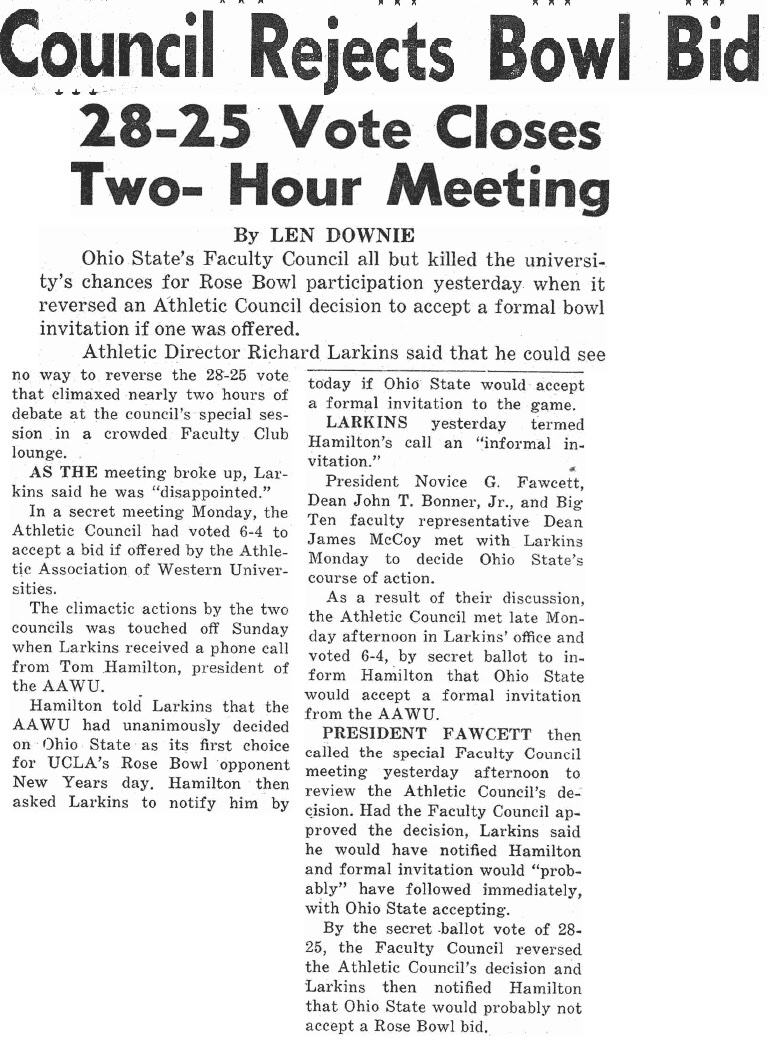
Hayes, while disappointed, understood that he had to obey faculty members above him. Many OSU players also sided with Hayes' comments and the decision.
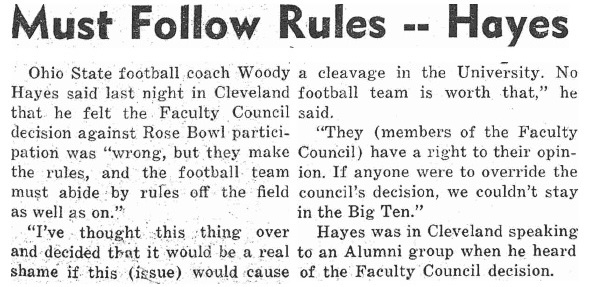
"Wrong, but they make the rules, and the football team must abide by rules off the field as well as on," Hayes said of the decision to skip out on the Rose Bowl. "I've thought this thing over and decided that it would be a real shame if this (issue) would cause a cleavage in the university. No football team is worth that.
"They (members of the Faculty Council) have a right to their opinion. If anyone were to override the council's decision, we couldn't stay in the Big Ten."
Following the decision, protests erupted on campus, which escalated into students marching downtown to voice their displeasure to the state capitol. But eventually, the protests stopped as fans accepted the outcome of the decision, thanks to football co-captain Mike Ingram.
“The team did all the damn work,” he yelled through a microphone. "If the team can accept the decision, you certainly can. Now go home.”
With Ohio State skipping out on the Rose Bowl, recruiting took a hit for Hayes' team.
“Players in Ohio think that Ohio State’s deemphasizing football: ‘They don’t want to go to bowl games,’ and talent started leaving the state,” Todd Jones, senior writer for the Alumni Magazine, said.
Due to that, Hayes changed the way he recruited and expanded the areas he recruited in, especially out of state. One player that benefited from that? Jack Tatum, a product of North Carolina and New Jersey and a member of a group of former Buckeyes considered the "Super Sophomores."
Ironically, Tatum helped lead Ohio State to a win over USC in the Rose Bowl later that decade, securing the 1968 national championship. Thanks to a 36-20 vote by OSU's faculty council following that title game, the Big Ten and the Rose Bowl approved a new contract in 1969.
With Minnesota defeating UCLA in the Rose Bowl, Ohio State was crowned national champions in 1961 by the Football Writers Association of America, despite rejecting a spot in the Rose Bowl.