Indiana's national championship roster had fewer than a dozen players Ohio State would have recruited out of high school.
The last four words in that sentence are doing enough heavy lifting to quality for Iron Buckeye honors. The Hoosiers went to two straight College Football Playoffs and ran the table the second time around in part because 5-year players are far more plentiful and reliable than 5-star recruits.
Curt Cignetti was forced into operating the way Ryan Day is now quickly adapting to years before he arrived in Bloomington, which is to overcome talent deficiencies with maturity. Necessity is the mother of invention, and Cig has still never coached at a destination program for high school legends - this is not a slight to IU.
No shame in buying secondhand talent, and in 2025 IU's 36 transfers represented nearly 65% of the Hoosiers' 1st string snaps. If you're wondering where that placed among FBS teams, it's the same as IU's final FBS ranking.
The 2025 Hoosiers had 47 players who were 22 or older, more than half of their scholarship players. When your roster has an influx of men who already learned how to play college football elsewhere, you can devote a lot less time to practicing. Cig's teams spend significantly more hours conserving themselves in walk-throughs and enduring shorter contact sessions than most programs, because they can.
There might not have been a more efficient or fresh program last season than the one in Bloomington which went 16-0, so last week when Day said that programs need to adapt or die, he wasn't being mysterious. He got a good look at both of the teams which played to unseat his own as national champion.
Michigan's 2023 roster Included 18 grad students. Ohio State's 2024 team was laden with seniors. Indiana's 2025 roster had 47 players who were at least 22 years old.
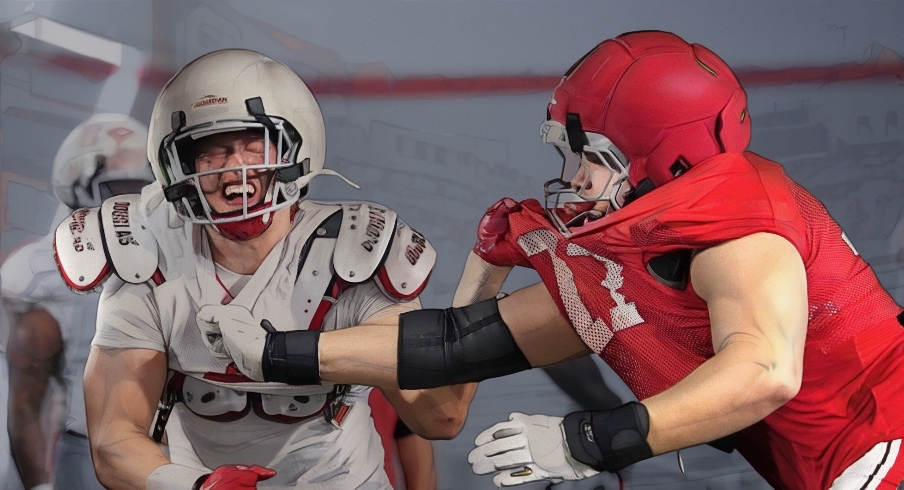
The spoiler atop this column encapsulates the roster piece of Ohio State's adaptation, and that's 3-star 5th-year North Carolina transfer Beau Atkinson battling incoming freshman standout and gigantic human-slash-priority recruit Sam Greer.
Don't get wrapped up vexing on Atkinson's performance thus far in Columbus, or the fact Greer still has his Black Stripe. This is the talent mix you can expect from the Buckeyes' rosters in the present and foreseeable future.
Unlike with the dinosaurs - which is what Day was referencing during his Adapt or Die press conference - four meteors struck the football program with the two recent and memorable ones being Indiana and Miami. IU kept the game close, got the Buckeyes to overthink everything and ultimately forced Ohio State's generationally yippish kicker to be the deciding factor.
Miami played cool and conservatively, allowed its grown men edge players to jump the Buckeyes' static snap count and asked its mid-20s players to execute simple plays in clutch moments. There was nothing dazzling about what the Hurricanes did in Arlington. It was just mature, like the Hoosiers in Indianapolis.
The third meteor was the 2023 Michigan Wolverines, which was harder to see from Columbus and largely obscured by several seasons where every game was foundationally rooted in explicitly forbidden pre-game reconnaissance. But once Connor Stalions was no longer part of Michigan's operation, the same team that looked lost against TCU in the CFP, largely on account of having nothing decoded at game time, was among the oldest and most mature the sport has ever seen a year later.
Their championship roster included 18 graduate students. Two years later, in what would be Sherrone Moore's final season, Michigan had the youngest team in the conference while starting a true freshman, albeit sensational quarterback - that philosophy of being older than everyone else apparently skipped town with Jim Harbaugh.
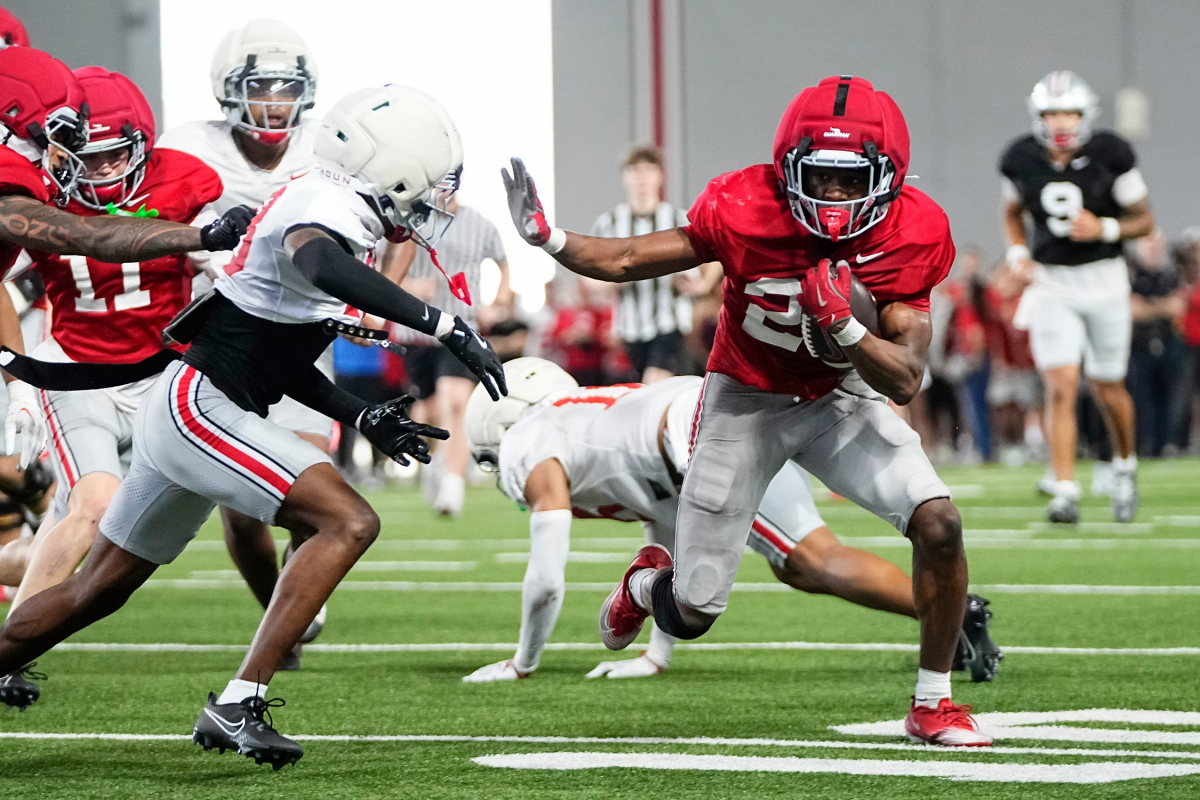
Incoming freshman running back Favour Akih runs past former Michigan, Alabama and Utah cornerback Cam Calhoun during Student Appreciation Day spring practice at the Woody Hayes Athletic Center on April 4, 2026. © Adam Cairns/Columbus Dispatch / USA TODAY NETWORK via Imagn Images
Bryce Underwood was the nation's top prospect coming out of high school, which in any other era - sure, you start that guy and hope he grows up quickly. By contrast, Fernando Mendoza, who transferred to Bloomington from Berkeley, was the state of Florida's 311th best player per the 247Sports composite as he entered college.
He'll be the top pick in the NFL Draft later this month. It's a drastic example, but the lesson is four years of college, coaching and elite talent evaluation are hard to beat. In IU's case last season, unbeatable.
Current UM basketball coach Dusty May figured it out years ago at Florida Atlantic, where from 2018-2024 he prioritized overlooked and international talent, the transfer portal, character and versatility. His methods were an open secret no one really paid attention to until he paired his philosophy with Michigan's resources. If you're shouting TAMPERING at your screen, couch that - different column.
The ultimate May player might be one he inherited and retained in Ann Arbor, Nimari Burnett. A McDonald's All-American who started at Texas Tech, transferred to Alabama and just completed his sixth year of college - a combination of talent and maturity who does not appear to be enamored by the enticement of G-League stipends.
He'd rather come off the bench at Michigan, which is part of the character evaluation May prioritizes. Burnett is older than Jaxon Smith-Njigba, the reining Offensive Player of the Year and highest-paid receiver in the NFL, now on his second contract.
Ohio State got one meaningful season out of JSN. Let's cross the football and basketball streams to ask an important question on adaptation: What type of player would you rather have?
For the non-poverty programs (Ohio State basketball should act like it lives among the wealthy, but couch those feelings for now) the answer is both. You now need mature reliability and generational youth blending together. This moment for Ohio State football may have crystalized without anyone realizing last season - not against the Hoosiers or Hurricanes, but when it faced the Scarlet Knights with both Jeremiah Smith and Carnell Tate unavailable.
If you don't buy into RYAN Day'S COMMENTS ON OHIO STATE NEEDING TO ADAPT, there are 51 reasons TO BELIEVE on the 2026 ROSTER.
Next man up was neither of the two 5-star recruits who are now at Notre Dame. It turned out to be walk-on and graduate student David Adolph, paired with heavy personnel (couch your TE feelings as well; different column). That brings us to the fourth meteor, which is where this metaphor falls apart. It was more of a gradual warming or radiation leak.
Brian Hartline was distracted while learning the OC ropes as the WR room beyond the three starters delivered arguably its most uninspired and disappointing season since 2011. Non-poverty programs don't have to retain coaches by allowing them to advance their career paths, multitask and learn new jobs on-site.
We may have finally reached the conclusion of Coaches Having More Than One Full-Time Job at Ohio State. That Adolph moment captured a lot more than we realized at the time.
Adolph was easier to trust - against Rutgers! - than either Quincy Porter or Mylan Graham, whose high school pedigrees and potential were among the best in the country coming out of high school. The staff believes Marcus Freeman will need to be patient with both of them, and replaced their headcount with veteran receivers who require less patience.
We'll see if they're right, but that brings us back to Adapt or Die. Who has the time to wait several seasons for elite high school talent to mature? It's rarely been Ohio State fans, it's no longer coaches - and if you look at the velocity of transfer portal entrants it's definitely not the players themselves.
The present and future of Ohio State football begins with annual reloading to ensure the program is both dynamic and seasoned enough to overcome the most veteran opponents they face that season. If you don't buy into Day believing in that adaptation, there are 51 reasons proving it to you on the roster, and you haven't quite memorized their jersey numbers yet.
Old and new, reliable and dynamic - for the roster and the staff. Ohio State football appears to be adapting to the reality of college athletics today - or at least until the next meteor arrives.