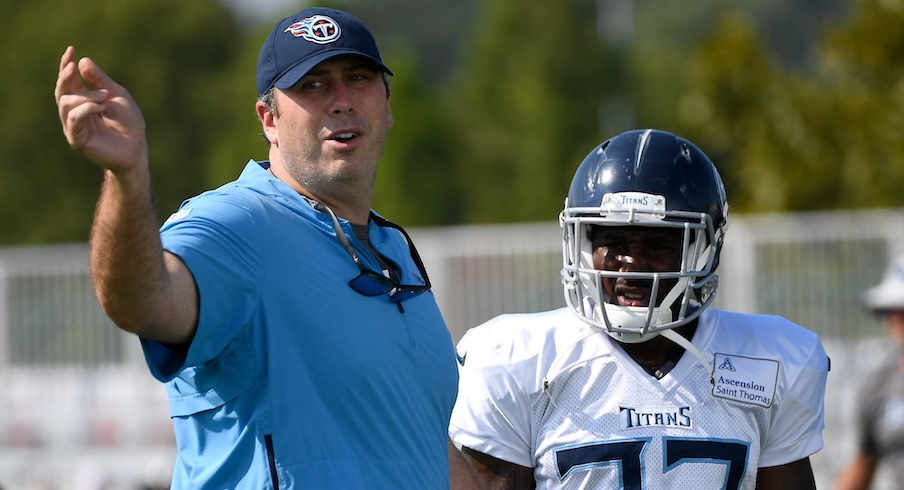
Arthur Smith’s offenses as the Tennessee Titans’ offensive coordinator ranked among the best in the NFL, but his offenses as the Atlanta Falcons’ head coach and Pittsburgh Steelers’ offensive coordinator didn’t reach the same heights.
Smith’s success in Nashville, along with his overall experience as an offensive play caller and head coach at football’s highest level, gave Ryan Day good reason to hire Smith as Ohio State’s new offensive coordinator. Hiring former NFL head coaches as coordinators is a strategy that’s worked well for Day, and Matt Patricia and Chip Kelly were also coming off uninspiring results in their most recent jobs when they arrived at Ohio State.
That said, the disappointing results of Smith’s offenses in Atlanta and Pittsburgh have drawn scrutiny as Ohio State fans wonder whether Smith is the right man to lead the Buckeyes’ offense – especially after a disappointing end to the 2025 season in which Ohio State scored just 24 total points in its final two games against Indiana and Miami.
With that in mind, we’re taking a closer look at how Smith’s offenses performed across his seven years as an offensive play caller in the NFL.
First, here’s a by-the-numbers look at how each of Smith’s offenses in Tennessee, Atlanta and Pittsburgh fared in terms of points per game, yards per game and play, passing yards per game and play and rushing yards per game and attempt, with the teams’ stats from each season and where they ranked among the NFL’s 32 teams in each of those categories.
| Year | Team | Points/Game | Yards/Game | Yards/Play | Pass YPG | Pass YPA | Rush YPG | Rush YPA |
|---|---|---|---|---|---|---|---|---|
| 2019 | Titans | 25.1 (10th) | 362.8 (12th) | 6.12 (4th) | 223.9 (21st) | 7.11 (6th) | 138.9 (3rd) | 5.00 (2nd) |
| 2020 | Titans | 30.7 (4th) | 396.4 (3rd) | 6.15 (4th) | 228.3 (23rd) | 7.16 (7th) | 168.1 (2nd) | 5.16 (2nd) |
| 2021 | Falcons | 18.4 (26th) | 303.8 (29th) | 5.13 (23rd) | 218.4 (16th) | 6.06 (17th) | 85.4 (31st) | 3.69 (30th) |
| 2022 | Falcons | 21.5 (T-15th) | 318.6 (24th) | 5.36 (16th) | 158.8 (31st) | 5.97 (18th) | 159.9 (3rd) | 4.86 (4th) |
| 2023 | Falcons | 18.9 (26th) | 334.3 (17th) | 5.20 (16th) | 207.3 (22nd) | 6.18 (17th) | 127.0 (9th) | 4.14 (16th) |
| 2024 | Steelers | 22.4 (16th) | 319.4 (23rd) | 5.02 (26th) | 192.0 (27th) | 5.96 (19th) | 127.4 (11th) | 4.06 (20th) |
| 2025 | Steelers | 23.4 (15th) | 305.6 (25th) | 5.26 (17th) | 202.4 (22nd) | 5.92 (21st) | 103.3 (26th) | 4.31 (17th) |
Smith’s Titans offenses were among NFL’s best
The Tennessee Titans have ranked in the top 10 in the NFL in scoring offense just twice in the last 22 seasons. Both of those seasons came with Smith calling their offensive plays – his first gig as an offensive coordinator, a role he was promoted into by then-Titans head coach Mike Vrabel after eight years as a quality control coach, offensive line coach and tight ends coach for the Titans.
In Smith’s first year as offensive coordinator, the Titans’ offense went from one of the NFL’s worst to among its best. The Titans gained over 50 more yards per game and scored 5.7 more points per game in 2019 than they did under previous offensive coordinator Matt LaFleur (who left to become the head coach of the Green Bay Packers) in 2018.
After ranking just 27th in the NFL in points per game and 26th in yards per play in 2018, the Titans’ offense became one of the NFL’s most dynamic in 2019, ranking fourth in the league in yards per play and 10th in points per game on their way to making the AFC Championship Game.
The Titans’ offense was even better in Smith’s second year on the job, ranking fourth in the league in points per game and third in the NFL in yards per game in 2020.
Running the ball is a big area where Ohio State will be looking for improvement under Smith, and Smith’s rushing offenses in Tennessee were elite, ranking second in the NFL with five-plus yards per carry in both seasons. Derrick Henry led the NFL in rushing in both seasons, including the best year of his career in 2020, when he ran for 2,027 yards – the fifth-most in a single season in league history.
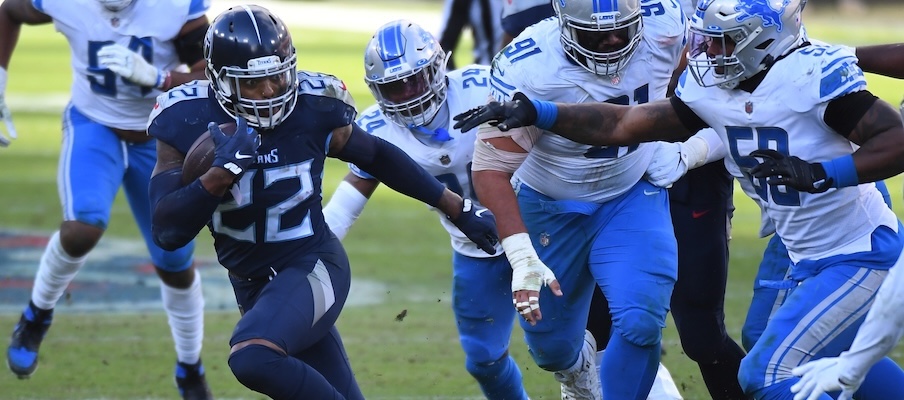
Derrick Henry ran for 2,027 yards in Arthur Smith’s offense in 2020. (Photo: Christopher Hanewinckel – Imagn Images)
Smith’s Titans offenses played to their strengths and ran the ball more than they passed it – especially in 2020, when they had the second-most rushing attempts in the league (521) – but they were effective through the air, too.
Excluding sacks (which count as passing plays rather than running plays in the NFL), the Titans led the NFL with 8.8 yards per passing attempt in 2019, but finished sixth in yards per passing play because they gave up 56 sacks, the third-most in the league. Their net yards per passing play increased from 7.11 to 7.16 (seventh-most in the league) in 2020 as they allowed only 25 sacks.
Ryan Tannehill led the NFL with a passer rating of 117.5 in 2019 and finished fifth in the league with a passer rating of 106.5 in 2020; those were the only two seasons in his 11-year NFL career in which Tannehill had a passer rating over 100. The Titans attempted far fewer passes than most of their counterparts, however, ranking 31st in the NFL in passing attempts in 2019 and 30th in the league in passing attempts in 2020.
Smith’s Titans offenses were elite in the red zone, finishing second in the league by scoring touchdowns on 75% of their red zone trips in 2019 and leading the league by scoring touchdowns on 75.6% of their possessions inside the opponent’s 20-yard line in 2020.
Smith’s Falcons offenses didn’t take flight
In his first and to this point only job as a head coach, Arthur Smith did what Day did for his first five years as Ohio State’s head coach, calling the Falcons’ offensive plays rather than delegating those duties to their offensive coordinator. Smith didn’t have the same success pulling double duty in Atlanta as he did when he could focus solely on the offense in Tennessee.
Smith went from guiding one of the NFL’s best rushing offenses in 2020 to one of its worst in 2021, when the Falcons ranked second-to-last in the league in rushing yards per game and third-to-last in rushing yards per attempt. Of course, it didn’t help that Smith went from an offense that had the NFL’s best running back to an offense whose leading rusher was Cordarrelle Patterson, a converted wide receiver.
That said, the Falcons’ passing offense was also middling in 2021. In what would end up being his final season with the Falcons, Matt Ryan failed to reach 4,000 passing yards for the first time in 11 years, even though the season was extended from 16 to 17 games.
Smith’s offense re-emerged as one of the NFL’s best rushing attacks in 2022 after the Falcons selected Tyler Allgeier in the fifth round of the NFL draft. Allgeier ran for 1,035 yards in his rookie season, and the Falcons ranked third in the league in rushing yards per game and fourth in the league in yards per carry.
With Marcus Mariota – who previously played for Smith in Tennessee – taking over quarterback duties from Ryan, however, the Falcons finished second-to-last in the NFL in passing yards. That was partially because Smith went back to a run-heavy offense, as the Falcons also had the second-fewest passing attempts in the league.
The Falcons ranked in the middle of the pack in both passing and running efficiency in Smith’s final season at the helm, finishing 16th in rushing yards and 17th in passing yards. But they finished just 26th in the NFL with 18.9 points per game, in large part because they had the league’s fourth-worst red zone offense, scoring touchdowns on just 46.8% of their red zone attempts.
Better things were expected from the Falcons’ offense after they used three straight top-10 picks on offensive playmakers: tight end Kyle Pitts in 2021, wide receiver Drake London in 2022 and running back Bijan Robinson in 2023. Quarterback play was a big factor in the Falcons’ 2023 struggles; Desmond Ridder began the year as the starter, but was ultimately benched for Taylor Heinicke. That said, the Falcons finished the season with a 7-10 record for the third year in a row, which led Falcons owner Arthur Blank to fire Smith after the season finale.
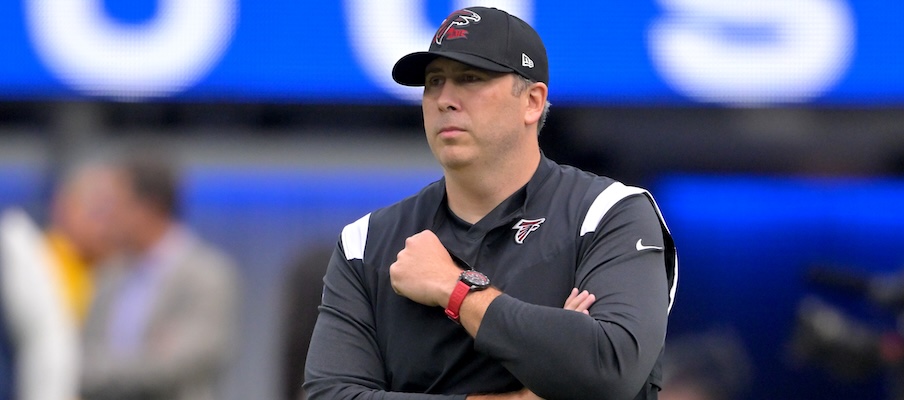
Arthur Smith was the Atlanta Falcons’ head coach from 2021-23, going 7-10 in all three seasons. (Photo: Jayne Kamin-Oncea – Imagn Images)
Smith’s Steelers offenses were mediocre
You won’t find many Steelers fans giving rave reviews of Smith’s tenure leading their offense over the past two years, but statistically, his offenses weren’t terrible, just average. Pittsburgh finished in the top half of the NFL in each of the last two seasons in points per game, but just barely, finishing 16th in 2024 and 15th in 2025.
That was enough for the Steelers to make the playoffs in both seasons, but Smith’s offenses ultimately faltered in the most important games of the year. The Steelers scored just 14 points against the Ravens in a 2024 wild card round loss, then only six points in a wild card round loss to the Texans in Smith’s final game with the Steelers earlier this month.
As with the end of his Falcons tenure, instability at quarterback played a part in the struggles of Smith’s Pittsburgh offenses, especially in 2024. As good as Justin Fields was at Ohio State, none of the NFL offenses he’s quarterbacked have had much success. Fields started the Steelers’ first six games in 2024 before Russell Wilson took over; Wilson averaged more than twice as many passing yards per game as Fields, but like Fields, Wilson was worse in 2025 after leaving Smith’s offense. Both Fields and Wilson were benched midway through the season in 2025 after signing with New York teams to be starting quarterbacks, so it’s hard to argue that Smith was set up for success with the quarterbacks he had in 2024.
More disappointing was that Smith’s offense didn’t make a substantial leap in 2025 after the Steelers signed future Hall of Fame quarterback Aaron Rodgers and traded for wide receiver DK Metcalf. Rodgers, who turned 42 in December, has been past his prime for a few years; nevertheless, he was an upgrade over the Wilson/Fields tandem. Yet the Steelers actually averaged fewer passing yards per attempt in 2025 than they did in 2024, finishing 21st in the league in that category.
Despite being pass-heavy compared to Smith’s previous offenses – the Steelers had the fifth-fewest rushing attempts (407) of any NFL team in 2025 – the Steelers finished 22nd in the league in passing yards.
How Smith’s NFL results could translate to Ohio State
The biggest advantage Smith will have at Ohio State relative to his NFL offenses is the talent he inherits at quarterback and wide receiver. While his best quarterbacks in Atlanta and Pittsburgh were players at the tail end of their careers in Ryan and Rodgers, he’ll enter 2026 with arguably college football’s best quarterback in Julian Sayin, the only one of last year’s Heisman Trophy finalists who’s still playing college football. He’ll also have one of the nation’s most talented receiving corps, led by a superstar in Jeremiah Smith, while most of his NFL offenses had limited depth at wideout.
Smith’s top-five rushing attacks in Tennessee and Atlanta are reason to be encouraged about Smith’s ability to get Ohio State’s running game back on track, but those offenses all had running threats at quarterback while his Tennessee offenses benefited from having the NFL’s best running back. How much Bo Jackson and Isaiah West improve in year two, whether Sayin can become more of a running threat and the development of the offensive line in front of them will all be key factors in whether Smith can build an elite rushing offense at Ohio State.
All seven of Smith’s offenses ranked in the bottom half of the NFL in passing attempts, so his hiring as offensive coordinator doesn’t align with the desire many Ohio State fans have for the Buckeyes to air it out more and lean more heavily on their passing attack. But if Smith can get Ohio State’s running game going after the Buckeyes ranked outside the top 50 in yards per carry this past season, it will change the way defenses play Ohio State and open up more downfield opportunities for Jeremiah Smith and the rest of the Buckeyes’ receivers. And Arthur Smith certainly could look to lean on the pass more than he ever has before now that he’ll be building an offense around Jeremiah Smith and Sayin.
Perhaps most importantly, Arthur Smith has spent the past seven years scheming up offenses at the highest level of football. The experience of coaching against NFL offenses clearly worked to Patricia’s advantage this past season, as Ohio State’s defense held opponents to fewer points and yards per game than any other FBS defense in the last 14 years. The hope now is that Smith’s NFL experience will make Ohio State’s 2026 offense both more innovative and more prepared for what other defenses might throw at it, allowing the Buckeyes to take full advantage of their offensive talent, with Sayin and Jeremiah Smith both entering their likely final season of college football before they jump to the NFL.
Smith’s Ohio State offense will have to be much better than his Atlanta and Pittsburgh offenses for the Buckeyes to achieve their national championship goals in 2026. But his years in Tennessee showed that he’s capable of building an elite offense, and he’ll have as much talent to work with relative to his competition at Ohio State as he’s ever had before.