Traveling to the West Coast has become an annual part of the Ohio State football season since the latest round of Big Ten expansion, but it used to be a far more rare occurrence.
When Ohio State traveled to Southern California for the second game of the 1941 season, it was just the third time in the 50-year history of Ohio State football that the Buckeyes played in the Pacific Time Zone. The first two trips didn’t go well for the scarlet and gray; Ohio State was shut out 28-0 in the 1921 Rose Bowl, then lost 13-12 in its first-ever game against USC in Los Angeles in 1937.
The Buckeyes’ second trip to the L.A. Coliseum, however, went far better than the first.
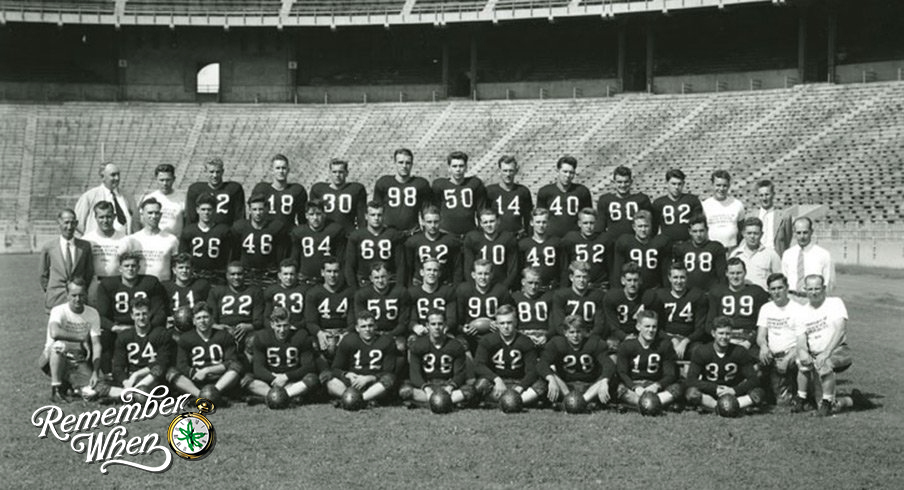
Although Ohio State was coming off a 12-7 win over Missouri in Paul Brown’s first game as head coach, beating USC was expected to be a tougher test for the Buckeyes. After all, just getting to Los Angeles was a three-day endeavor for the Buckeyes in those days; they left Columbus by train on Wednesday, stopping in Chicago to practice that day and in Albuquerque, New Mexico, to practice on Thursday before arriving in Los Angeles on Friday.
The game got off to a precarious start for the Buckeyes when Ohio State’s Tom Kinkade lost a fumble that USC recovered at Ohio State’s 49-yard line on the Buckeyes’ opening drive, but Ohio State’s defense stood stout to force a punt. USC got an even shorter field for its second possession after a low, wobbly punt by Ohio State’s John Hallabrin went out of bounds at the 26-yard line, but the Buckeyes made a fourth-down stop on a fake reverse to force a turnover on downs.
Ohio State drove 83 yards down the field on its third possession, with Jack Graf running for a 2-yard touchdown that was set up by a run by future Heisman Trophy winner Les Horvath, a backup halfback for Ohio State at the time. Dick Fisher scampered for 46 yards on a fake punt run on Ohio State’s fourth possession, setting up a 17-yard touchdown run by Charlie Anderson to put the Buckeyes up 13-0 before the end of the first quarter.
USC got another short field in the second quarter when it blocked a Hallabrin punt, but Kinkade intercepted a pass by USC’s Mickey Anderson in the end zone. The Buckeyes drove the ball 80 yards down the field, with Fisher rushing for a touchdown, to make it 20-0 before halftime.
Bob Shaw made a leaping catch on a pass from Graf and turned it into a 48-yard touchdown on Ohio State’s second possession of the third quarter to extend the Buckeyes’ lead to 27-0. After a fumble by Graf on Ohio State’s next series, Fisher intercepted a pass by USC’s Bobby Robertson. The Buckeyes drove from their 13-yard line all the way down the field on their subsequent possession, with Fisher gaining 10 yards on another fake punt and eventually finishing the drive with his second touchdown run of the game to make it 33-0.
| Year | Opponent | Yards |
|---|---|---|
| 1950 | SMU | -31 |
| 1969 | NORTHWESTERN | -29 |
| 2024 | OREGON (ROSE BOWL) | -23 |
| 1942 | FORT KNOX | -14 |
| 1977 | MIAMI (FL) | -13 |
| 2003 | INDIANA | -12 |
| 2008 | YOUNGSTOWN STATE | -11 |
| 1941 | USC | -9 |
| 2005 | IOWA | -9 |
Ohio State took most of its starters out of the game after that drive, but even with backups on the field, the Buckeyes preserved their shutout through the fourth quarter. USC finished the game with only 67 total yards of offense, including a net total of -9 rushing yards, which still ranks among the 10 lowest single-game totals ever for an Ohio State opponent.
The win was Ohio State’s first in three games against USC, who had also earned a 14-7 win over the Buckeyes in Columbus in 1938. The 33-0 result is still the most lopsided victory Ohio State has ever earned against USC – though the Buckeyes have beaten the Trojans nine more times since – and it was considered one of the greatest performances in Ohio State history when it happened.
“It was, to an Ohio stater, one of the most remarkable and soul-satisfying games a scarlet eleven ever has played,” sports editor Russ Needham wrote in his article for the following day’s edition of The Columbus Sunday Dispatch. “It was so good, and this is a fact, that dyed-in-the-wool Trojan rooters could do naught but gasp in admiration.”
USC never bounced back from that loss, finishing the year 2-6-1 in its lone season led by Sam Barry, who also coached USC’s basketball and baseball teams and took over as football coach just two months before the season following the death of longtime coach Howard Jones. Ohio State, on the other hand, went 6-1-1, suffering its only loss of the season vs. Northwestern and tying Michigan, 20-20, in its season finale.
Brown’s successful first season at the helm set up Ohio State’s first-ever national championship season in 1942, when the Buckeyes finished the year as the No. 1 team in the AP poll after going 9-1-1 with a 21-7 over Michigan.
“It was, to an Ohio stater, one of the most remarkable and soul-satisfying games a scarlet eleven ever has played.”– Columbus Dispatch sports editor Russ Needham on Ohio State’s 33-0 win over USC in 1941
Ohio State will hope to achieve a similar result against USC to that which it earned 85 years ago when it returns to the L.A. Coliseum for the first time since 2008 to play the Trojans this fall. It will be Ohio State’s first meeting with USC since the Trojans joined the Big Ten in 2024. The date for that game, along with the rest of the Big Ten schedule, will be announced Tuesday at 5:30 p.m. on Big Ten Network.