Another Big Ten school not named Michigan will have to vacate wins after an NCAA probe.
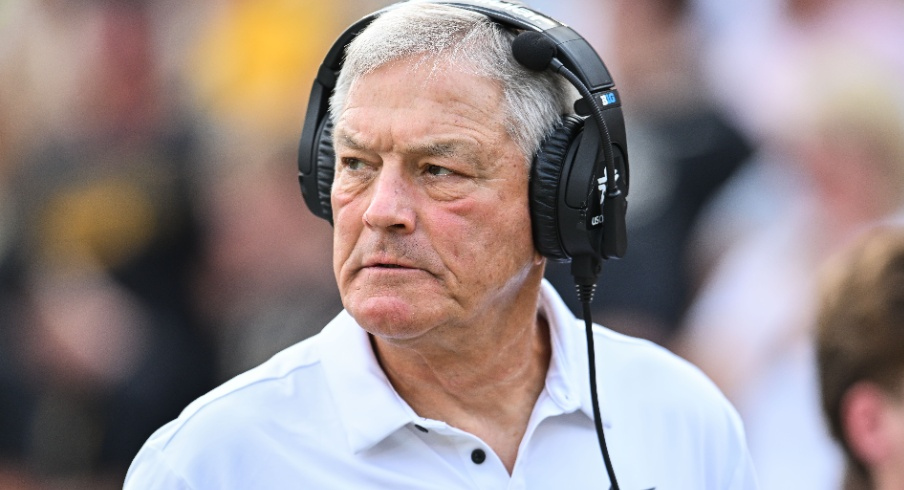
On Tuesday, the NCAA announced tampering violations involving Iowa head coach Kirk Ferentz, assistant coach Jon Budmayr and the Hawkeyes’ football program.
According to the official release, Budmayr engaged in 13 phone calls and sent two text messages to former Michigan quarterback Cade McNamara (and/or his father) while McNamara was still enrolled at another university. Budmayr also facilitated a phone call between the athlete and Ferentz. Shortly after these communications, McNamara entered the transfer portal and committed to Iowa.
“Under current NCAA rules, when a student-athlete transfers to a school that engaged in tampering, the student-athlete becomes ineligible pending reinstatement,” the release states. “The student-athlete competed during the 2023 season before being reinstated.”
The NCAA classified all violations in this case as Level II-Mitigated. Penalties for Iowa’s violations include:
- One year of probation.
- A fine of $25,000 (self-imposed by the school).
- A two-week ban on all football recruiting communication during the 2026 calendar year (self-imposed by the school).
- A 24-day reduction in recruiting person days, including two weeks during which Ferentz was prohibited from off-campus recruiting activity in 2025, as well as four days during which Budmayr was prohibited from recruiting during the 2025 spring evaluation period (self-imposed by the school).
- A vacation of all records in which the student-athlete competed while ineligible.
- A one-game suspension for Ferentz and Budmayr during the 2024 football season (self-imposed by the school).
Ferentz and Budmayr resolved their cases through negotiated resolutions and have already served their suspensions. Ferentz has publicly accepted accountability for the violations. The infractions panel noted that this "lapse in judgment" did not call into question Ferentz’s overall integrity or his decades-long track record of running a compliant program, praising his cooperation and contrition.
"When respected individuals identify their mistakes and take responsibility for them, it sets the standard for appropriate behavior within their programs, universities and, more importantly, across the broader industry," the panel said. "The panel appreciates the actions taken by Iowa and Ferentz to publicly address his and his staff member's conduct."
The case ultimately moved to an infractions hearing because Iowa contested the "vacation of records" penalty, arguing that the practice is outdated. However, the NCAA maintained that vacating wins remains a standard tool for addressing the competitive advantage gained by using ineligible players, rather than a punishment aimed at future teams or coaches.
Consequently, the panel concluded that under the current infractions framework, the vacation of records remains the appropriate penalty. However, the panel did acknowledge that the evolving landscape of collegiate athletics necessitates a regular reevaluation of the rulebook, including the severity and nature of consequences for violations.
"Changes to historical practice — particularly around what violations trigger student-athlete ineligibility and how ineligible competition is penalized — should be made by more traditional governance committees through the governance and legislative process," the panel said. "The COI is open to reevaluating the violations that trigger ineligibility or how ineligible competition should be penalized, but it would be inappropriate to do so in the context of a single infractions case and outside of the legislative process.”
In November 2025, the NCAA had Michigan State vacate wins and imposed other penalties after former staffers Saeed Khalif and Brandon Jordan committed recruiting violations under former head coach Mel Tucker.
Both Iowa and Michigan State’s penalties stand in contrast to those the NCAA handed Michigan after the Connor Stalions’ scandal. Despite evidence Stalions and other staffers participated in an illegal advanced-scouting scheme, the most severe penalties Michigan received included four years of probation, a significant fine and a brief prohibition on recruiting communications.
