Tom Cousineau was Mr. Can't Miss coming out of Ohio State.
From the moment the freshman linebacker from Cleveland's Lakewood St. Edward drew Woody Hayes' ire in practice for thumping All-Big Ten fullback Pete Johnson on back-to-back plays, all the way through leaving the program three years later owning every tackling record you can think of, there was little doubt Cousineau was one of the best players to ever wear the Scarlet and Gray.
Woody's "Sentinel" owned the program marks for the most total tackles in a season (211), the most solo tackles in a season (142), the most tackles in a game (29), and the most solo tackles in a single game (16).
The two-time All-American and the Chicago Tribune's Big Ten MVP for the 1978 season wasn't just productive, he was unavoidable. And the NFL couldn't wait to get its hands on him.
The Buffalo Bills held the top pick in the 1979 NFL Draft, thanks to a trade the previous season that sent O.J. Simpson to San Francisco. Cousineau was in the building at New York's Waldorf-Astoria Hotel, fully expecting to go first overall. The linebacker was rated as the top available player by scouting services leading up to the draft. The New York Times, writing about the draft, went so far as to say, “The surprises will begin after the Cousineau selection.”
The Bills did what everyone expected, selecting Cousineau with the first pick of the draft. It was a program first for Ohio State – having a player taken first overall 43 years after Gomer Jones became the first Buckeye ever taken in the NFL's very first draft.
The Bills had the center of their defense locked up for the next decade.
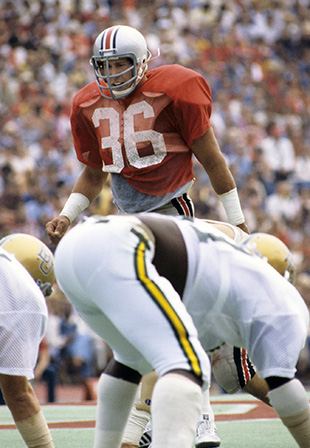
Cousineau in action against Baylor in 1978.
Photo: Malcolm Emmons-Imagn Images
Photo: Malcolm Emmons-Imagn Images
Or so they thought.
Buffalo owner Ralph Wilson played hardball during contract negotiations, even suggesting that Cousineau try the market if he was unhappy with the reported $1.2 million for five years that the Bills were offering.
Cousineau did just that, turning his eyes to the Canadian Football League.
The linebacker, who was of French descent, found a suitor in the Montreal Alouettes, who offered the Ohio State star $150,000 per year and a signing bonus of $200,000.
Not quite three months after he was taken first overall in the 1979 NFL Draft, Cousineau shocked the football world by accepting the Alouettes' offer to play in the CFL.
It marked the first time since 1960 that the first selection in the NFL Draft had opted to play for another professional football league. The surest thing in the NFL Draft was gone.
“I think I can be very effective because the game is fast and wide open,” Cousineau told the New York Times after making his decision.
The linebacker proved himself in the CFL, earning Grey Cup Defensive MVP honors his rookie season and winning the James P. McCaffrey Trophy as the outstanding defensive player in the CFL's East Division following his second season.
Cousineau also starred on the microphone. Following a 47-6 loss to Edmonton, he quipped, “Now I know what Northwestern feels like.”
After three seasons in the CFL, Cousineau opted out of the final two years of his deal with Montreal to play in the NFL. His timing couldn't have been better. After years of throwing big money around to lure the likes of Cousineau and Los Angeles Rams quarterback Vince Ferragamo, the Alouettes were in financial trouble.
The Bills still held Cousineau's rights. Or at least they kind of did. They were able to negotiate with the star linebacker and failing that, were given the opportunity to match any other NFL team's best offer.
The Houston Oilers stepped forward with the best offer: $2.5 million for five years, including a $500,000 signing bonus. Buffalo had 10 days to decide whether to lose Cousineau or match the Oilers' offer. The problem? It was too rich for the Bills.
They soon found a savior in the Cleveland Browns and owner Art Modell, who had long coveted the local product. The Browns' offer was accepted by the Bills, and the team immediately traded the linebacker to Cleveland in exchange for a first-, a second-, and a third-round draft choice. That first-round pick later became Hall of Fame quarterback Jim Kelly, a legend in Buffalo.
“I'll have to remember to send Bud Adams a Christmas card,” Cousineau was quoted as saying at the time, referring to Houston's owner.
He would play four seasons in Cleveland, earning second-team All-Pro honors in 1984, and then two more seasons with the San Francisco 49ers, before retiring and returning to Ohio. In 2016, he was inducted into the College Football Hall of Fame.
Ohio State has produced Heisman winners, Hall of Famers and national champions.
But its first No. 1 overall pick might still be the most unusual. A Buckeye so good he went first, and so valuable he reshaped two franchises without ever playing for one of them.